Most "Best Otter alternatives" roundups have the same problem: every tool reviewing Otter ends up ranking itself #1, and Otter's own roundups rank Otter #1 too. Neither version helps you actually pick a tool. This roundup is structured differently — every tool below gets a clearly-stated "best for" and "where it's the wrong fit," including Subanana, which I run.
Otter is genuinely strong for the case it was built for: English-only US teams inside the Zoom + Salesforce + HubSpot stack, with the HIPAA add-on for regulated industries. If that's your shape, this entire roundup might be premature — Otter probably is the right tool. The reasons teams move off Otter typically reduce to three categories:
- Non-English meetings — non-English or mixed-language content where Otter's English-first accuracy struggles, or proper-noun-heavy meetings where brand and technical terms get mistranscribed unless they are pre-loaded into a cross-language glossary.
- Integration mismatch — teams that live in CRMs Otter doesn't cover deeply, or that need conversation analytics (sentiment, talk-listen, topic tracking) Otter doesn't surface.
- Pricing fit — teams where per-seat scales worse than per-workspace, or where Otter's free tier is too constrained for the actual use case.
The 6 alternatives below are sized to those three categories.
Disclosure: I run Subanana. Every figure and capability claim about every tool below comes from each tool's published documentation — pricing pages, features pages, integration lists — pulled in May 2026. No fabricated head-to-head accuracy benchmarks; if you want accuracy testing on your audio, every tool here has a free tier or free trial.
TL;DR — which Otter alternative fits which buyer
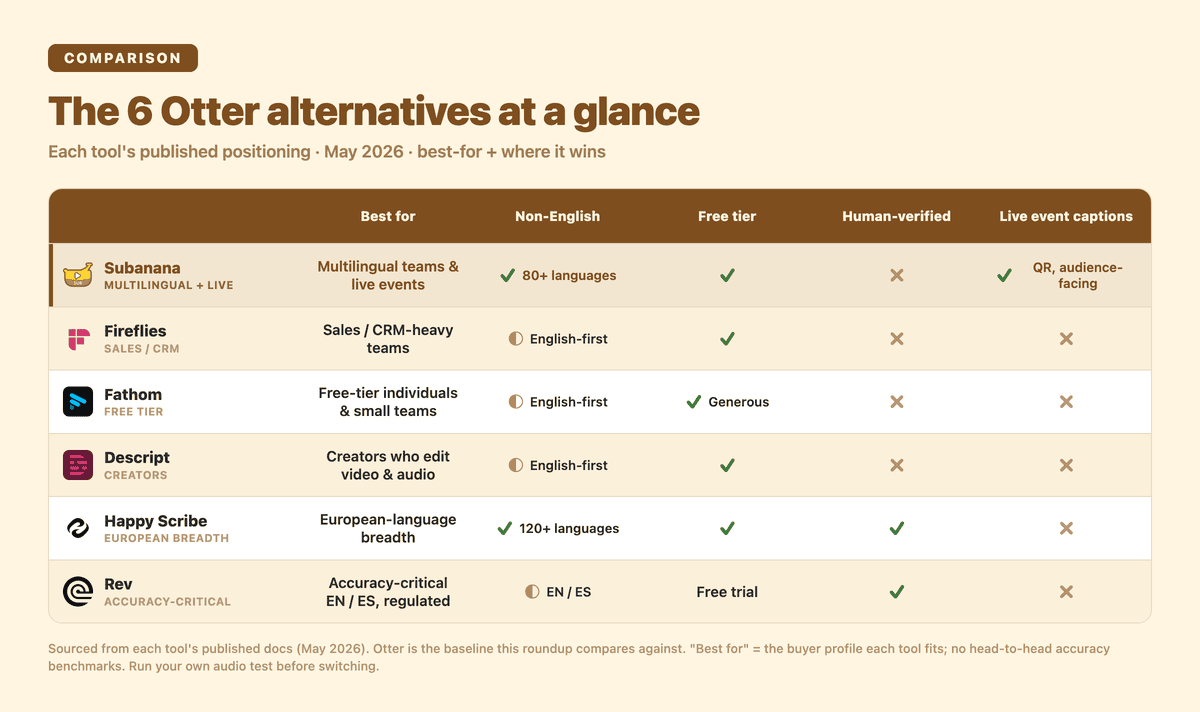
- Sales / CRM-heavy team that wants conversation analytics → Fireflies. 100+ integrations including Salesforce, HubSpot, Affinity, Pipedrive; sentiment / topic / talk-listen analytics built in.
- Free-tier individuals or small English-only teams → Fathom. Generous free tier (unlimited recordings + AI summaries), native Salesforce / HubSpot sync, HIPAA + SOC 2 on paid tiers.
- Creators who also need video editing, podcast production, voice cloning → Descript. Transcription inside a full creator studio, not standalone.
- European-language breadth or human-verified transcription → Happy Scribe — 120+ languages, optional human-verified tier, plus Happy Scribe FCPXML / STL / EDL exports for established subtitle workflows.
- English / Spanish accuracy-critical legal / broadcast / healthcare → Rev. Human-verified tier, HIPAA / CJIS compliance.
- User-selectable LLM summaries, glossary-driven proper-noun accuracy, workspace pricing, or live multilingual events → Subanana. 95+ language coverage with best-per-language model routing; glossary across all languages; live captioning as a separate feature with audience-facing QR captions.
When Otter is still the right call
Before you switch, check whether your reason for leaving actually requires switching. Otter still wins for:
- Pure English meetings inside the US workplace stack (Zoom + Salesforce + HubSpot + Microsoft 365). Otter's integration depth here is hard to beat.
- HIPAA-required healthcare workflows where Otter Enterprise's HIPAA add-on is already certified for your use case.
- Team familiarity / switching cost when no specific gap is forcing the move. "We've always used Otter" is not a problem worth solving.
If none of those apply, the rest of this post is the right list.
1. Fireflies — best for sales / CRM-heavy teams
Where it's stronger than Otter: Fireflies advertises 100+ integrations including Salesforce, HubSpot, Affinity, Pipedrive, and most of the CRM landscape. On top of transcription it ships sentiment analysis, topic tracking, and talk-listen ratio — conversation analytics that revenue-operations teams use for coaching and pipeline visibility. If your team's daily workflow is "meeting → CRM activity log → coaching review," Fireflies is purpose-built for that loop in a way Otter isn't.
Where Fireflies is the wrong fit: non-sales workflows where the CRM integration depth is wasted, or non-English meetings where the analytics layer can't compensate for transcription drift. Fireflies' core STT shape is also English-first.
Documentation-based deep dive: Subanana vs Fireflies (2026)
2. Fathom — best for free-tier individuals and small English-only teams
Where it's stronger than Otter: Fathom's free tier is genuinely generous — unlimited recordings, unlimited transcriptions, unlimited AI summaries, with native Salesforce and HubSpot sync. Otter's free tier is more constrained. Fathom's paid tiers add HIPAA and SOC 2 Type II for regulated industries. For an individual sales rep or a small English-only team with light per-user usage, the free tier may cover the entire workflow without hitting a paywall.
Where Fathom is the wrong fit: non-English content, larger teams where per-seat pricing starts to compound, or workflows that need flexibility in summary model choice or live multilingual captioning.
Documentation-based deep dive: Subanana vs Fathom (2026)
3. Descript — best for content creators who also need video editing and voice cloning
Where it's stronger than Otter: Descript isn't really a meeting transcription tool — it's a creator studio where transcription is one feature among many. Multitrack audio editing, video editing, AI voice cloning (Overdub), AI avatars, screen recording, Studio Sound noise reduction, and Brand Studio with 30+ language AI dubbing. If you produce podcasts, YouTube content, or course videos and want transcription inside the editor rather than as a separate tool, Descript is purpose-built for that.
Where Descript is the wrong fit: pure meeting transcription where the creator-studio overhead is wasted, non-English / mixed-language meeting content, or teams that don't produce published video / audio at all.
Documentation-based deep dive: Subanana vs Descript (2026)
4. Happy Scribe — best for European-language breadth and human-verified transcription
Where it's stronger than Otter: Happy Scribe's language coverage is broader (their published roster covers 120+ languages, especially strong on European languages — French, German, Spanish, Portuguese, Italian, Dutch and many more). It has an optional human-verified transcription tier for projects where 95-99% accuracy matters more than turnaround time. Happy Scribe's export format breadth — FCPXML, STL, and EDL — also covers established subtitle and broadcast workflows. Brand is mature (6M+ users per their public marketing).
Where Happy Scribe is the wrong fit: workflows that need glossary-driven proper-noun accuracy, user-selectable summary LLM, live multilingual event captioning with audience-facing display, or per-workspace pricing that scales better than per-user / per-hour structures.
Documentation-based deep dive: Subanana vs Happy Scribe (2026)
5. Rev — best for accuracy-critical English / Spanish in regulated industries
Where it's stronger than Otter: Rev is the human-transcription specialist with an AI tier on top. For legal proceedings, broadcast captioning, healthcare documentation, or anywhere a wrong word is expensive, Rev's human-verified tier delivers an accuracy guarantee that pure-AI tools can't match. HIPAA and CJIS compliance makes Rev usable inside regulated industries that limit which tools they can adopt. Per-seat AI plans scale to very high monthly minute allowances (5,000-10,000 min/seat at upper tiers) for users who transcribe heavily.
Where Rev is the wrong fit: non-English-or-Spanish content, smaller teams where the per-seat compliance pricing is overhead, or live event captioning where the meeting/file-based model doesn't fit.
Documentation-based deep dive: Subanana vs Rev (2026)
6. Subanana — best for multi-LLM summary control, glossary accuracy, and live multilingual events
Disclosure noted at the top still applies — I run Subanana, so calibrate framing accordingly. Three specific places where Subanana is the strongest fit on this list:
- 95+ language transcription with best-per-language model routing plus glossary support. The underlying STT layer continuously benchmarks multiple frontier models per source language and routes each transcription to the best-evaluated one — so accuracy on a given language tracks the best-performing model rather than being locked to a single vendor. Glossary across all languages boosts brand names, technical terms, and people's names that English-first STT consistently mistranscribes.
- User-selectable LLM for meeting summaries. Most tools in this list write summaries with one fixed LLM. Subanana lets you pick which model writes your summary; as new frontier models ship, the roster expands.
- Live captioning as a separate feature with audience-facing QR captions. For multilingual conferences, university lectures, hybrid webinars, and community events, Subanana's live caption takes direct audio input (mic, system audio, virtual cable) and produces real-time captions with translation in host-configured target languages. Attendees scan a QR code, view captions in their phone browser, and pick source / translated / both display — no app install. This shape isn't covered by Otter or most meeting-bot-first tools.
Where Subanana is the wrong fit: English-only US-stack teams where Otter / Fireflies / Fathom's integration depth is the deciding factor; pure creator studios where Descript's video editing matters more than transcription quality; regulated industries where Rev's compliance certifications are the binding constraint; European-language breadth where Happy Scribe's 120+ language roster and FCPXML / STL / EDL exports matter more than glossary + multi-LLM summary.
Product: Subanana — multilingual transcription & live captioning
How to evaluate two finalists on your actual audio
Picking the right Otter alternative on documentation alone takes you ~80% of the way. The remaining 20% — does this tool actually handle MY audio? — needs a real test. The process that works:
- Record a 10-minute test session representative of your actual content — same speakers, same language mix, same audio conditions (room, microphone, accents).
- Run that audio through each finalist's free tier. Every tool above except Rev has a free tier; Rev offers a free trial.
- Compare on three axes: transcription accuracy (count substitution / deletion errors on a 200-word reference sample), summary quality (does the AI summary capture what the meeting was actually about?), workflow fit (does the export format work with your downstream tools?).
- Pick on the audio, not the marketing. Every tool's marketing reads as "we have the best accuracy"; reality is language- and audio-specific. Your test recording settles it in an afternoon.
Frequently asked questions
Why are most "Otter alternative" roundups untrustworthy?
Most are written by competitors who rank themselves #1, or by affiliate sites with revenue tied to driving signups to specific tools. The "self-rank #1" pattern is universal in this category — every tool's own roundup names its own product as the top choice. The honest version is to state which tool you run upfront and concede where competitors genuinely win.
Is Otter still the best choice for some teams?
Yes. English-only US teams inside the Zoom + Salesforce + HubSpot stack, healthcare workflows where Otter Enterprise's HIPAA add-on is already a fit, or teams with significant existing investment where no specific gap forces a move. "Already works" is a legitimate reason to stay.
Which Otter alternative has the most generous free tier?
Fathom — unlimited recordings, unlimited transcriptions, unlimited AI summaries on the free tier (with native Salesforce / HubSpot sync). For English-only individual use, you can often run the entire workflow without hitting a paywall.
Which Otter alternative handles non-English or mixed-language meetings?
Subanana covers 95+ languages with multi-model evaluation and best-per-language routing, plus glossary support across all languages for proper nouns and brand terms. Happy Scribe has a 120+ language roster (especially strong on European languages) but doesn't publish per-language accuracy. Otter itself, Fireflies, Fathom, Descript, and Rev are English-first and don't publish meaningful non-English coverage.
Which Otter alternative is best for live event captioning?
Otter and most meeting-bot-first alternatives aren't designed for live event captioning with audience-facing display. The two tools in this category that handle live multilingual events with audience-facing captions are Subanana (browser-based, QR code distribution, no app install) and Wordly (enterprise live translation with 3,000+ language pairs, MP3 voice dubbing, deep platform integrations) — they're not in this roundup because they're a different category from meeting transcription, but if live events are your need, see the Subanana vs Wordly comparison.
Can I migrate transcripts from Otter to another tool?
Most tools above export transcripts in SRT, TXT, or DOCX, so historic Otter transcripts can be downloaded and re-imported elsewhere as text files. What doesn't transfer cleanly: AI summaries (each tool's summary structure differs), CRM-synced metadata, and integration history. Switching cost is higher for teams deep in Otter's ecosystem than for individuals.
Related guides
- Best AI Meeting Transcription Tools 2026: A Documentation-Based Roundup
- Subanana vs Otter (2026): A Documentation-Based Comparison
- Subanana vs Wordly (2026): Live Caption Comparison
Related: if you're choosing mainly for non-English or mixed-language meetings, see why a tool's language count is the wrong thing to compare — plus a 20-minute test to run on your own audio.