Wordly is the live-translation incumbent for enterprise events — 3,000+ language pairs, deep platform integrations, managed onboarding, MP3 voice dubbing, established brand (1B+ minutes per their published milestone). For large multi-day flagship conferences with a procurement budget for enterprise tooling, Wordly is purpose-built for the shape.
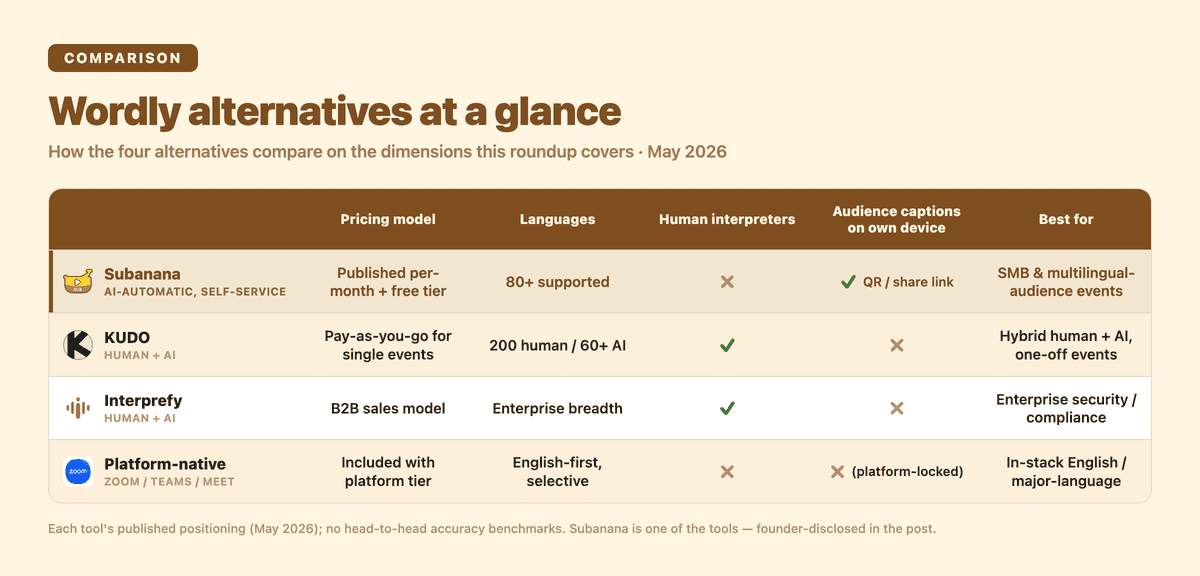
At-a-glance: how the four Wordly alternatives compare on the dimensions this roundup covers.
The reasons teams look for a Wordly alternative typically reduce to three:
- Pricing model fit. Wordly's 10-hour minimum + 12-month expiry + "Contact Sales for a Quote" gating is overhead for smaller event volume.
- Validation friction. "Can we trial this on one event before committing?" is harder when the smallest package is annual.
- Specific use case — a university lecture series, a hybrid webinar, an event with multilingual audience that needs audience-facing browser captions instead of in-platform integration.
The 4 alternatives below cover those three categories. Disclosure: I run Subanana, one of the tools below. Every capability claim is sourced from each tool's published pages (May 2026); no fabricated head-to-head benchmarks.
TL;DR — which Wordly alternative fits which buyer
- Large multilingual events that need both human interpreters and AI translation, with pay-as-you-go for one-off events → KUDO. 200 spoken + sign languages with human interpretation, 60+ with AI; no-annual-subscription path for single events.
- Enterprise multilingual events with security / compliance requirements (ISO 27001, end-to-end encryption) → Interprefy. Enterprise-focused, human + AI hybrid, B2B sales model.
- English-only or major-language events already inside Zoom / Teams / Meet → Platform-native live translation. Zoom AI Companion live translation, Microsoft Teams live translation, Google Meet captions — already in your stack, single-language output, English-first.
- SMB events, university lectures, hybrid webinars, or any event with a multilingual audience needing audience-facing browser captions → Subanana. Published per-month pricing, no annual commitment, free tier for validation, host configures source + target languages across 95+ supported languages with audience QR-code display.
When Wordly is still the right call
Don't switch off Wordly if your event shape is:
- Multi-day flagship conference for 500+ attendees across 8+ languages where Wordly's 3,000+ language pair breadth covers your audience completely.
- Procurement framework that prefers annual hour packages with volume + multi-year discounts; if your finance team is comfortable with that pricing shape and unused hours don't represent dead money, Wordly's per-hour cost can be very competitive at volume.
- Need MP3 voice dubbing of translated speech alongside the speaker's audio; Wordly's Voice Transcripts feature is the standout in this category and the only tool below that matches it is KUDO (with human interpreters).
- Already committed to a Wordly contract and no specific gap is forcing a re-evaluation. Switching cost matters; "I want to try a different tool" is not always worth the migration.
If none of these apply, the rest of this list is the right one.
1. KUDO — best for hybrid human + AI translation with pay-as-you-go option
Where it's stronger than Wordly: KUDO is built around both human interpretation and AI speech translation, with the human-interpreter marketplace as the headline feature. Published roster: 200 spoken and sign languages with human interpretation, 60+ with AI. The "Human Interpretation / AI + Platform Pay As You Go" option lets organisations book a single one-off event without any annual subscription — a clear pricing-flexibility win over Wordly's 10-hour-minimum-12-month-expiry model. Strong vertical positioning in government, education, houses of worship, and corporate.
Where KUDO is the wrong fit: smaller-scale events where the human-interpreter overhead is unnecessary (and where pure AI is fine), or workflows that need deep platform integration with Zoom / Teams that Wordly does more polished today.
2. Interprefy — best for enterprise events with strict security / compliance needs
Where it's stronger than Wordly: Interprefy's positioning is "enterprise multilingual communication" with ISO 27001 certification, end-to-end encryption, controlled access, and interpreter NDAs as part of the published security posture. Like KUDO, it ships both human remote simultaneous interpretation and AI speech translation. The target buyer is global enterprises with security review processes that need the compliance documentation upfront.
Where Interprefy is the wrong fit: smaller events where the enterprise security overhead is unnecessary, or SMB / academic / community buyers where the B2B sales motion is too heavy for the use case.
3. Platform-native live translation — Zoom, Microsoft Teams, Google Meet
Where it's stronger than Wordly: zero new vendor relationship. If your event is hosted entirely inside Zoom / Teams / Meet and you already pay for the platform's higher tier, you may already have live transcription / translation built in. Zoom AI Companion includes live translation; Microsoft Teams includes live translation; Google Meet captions are widely available.
Where it's the wrong fit: platform-native translation is English-first with selective major-language support. Mixed-language content and many less-resourced languages either aren't supported or produce captions that need heavy correction. Audience-facing display is also platform-locked — attendees see captions inside the meeting window, not on their own devices via a separate share link. For multilingual audiences with their own devices, platform-native translation doesn't cover the shape.
4. Subanana — best for SMB events, multilingual audiences, and pay-as-you-go validation
Disclosure noted at the top. Where Subanana is the strongest fit on this list:
- Published per-month subscription pricing — no hour packages, no annual commitment, no "Contact Sales for a Quote" gating for standard use. Free tier exists for single-event validation.
- 95+ language coverage with best-per-language model routing. The underlying STT layer continuously benchmarks multiple frontier models per source language and routes each transcription to the best-evaluated one, so accuracy on a given language tracks the best-performing model rather than being locked to one vendor. Glossary support across all languages boosts speaker names, organization names, and event-specific terminology.
- Audience-facing browser captions with no app install. The host configures source + target languages before the event; attendees scan a QR code or open a share link, view captions in their phone browser, and pick source / translated / both display — choosing among the languages the host pre-configured. Works regardless of whether attendees are in-person or remote, on whichever device they brought.
Where Subanana is the wrong fit:
- 3,000+ language-pair breadth (Subanana's 95+ language roster is narrower than Wordly's, KUDO's 200 human-language roster, or Interprefy's enterprise breadth)
- AI voice dubbing (MP3 audio output of translated text) — Subanana produces text captions only; for MP3 voice dubbing, Wordly's Voice Transcripts or KUDO's human interpreters are the right choices
- Human interpretation — Subanana is AI-only; if your event needs licensed human simultaneous interpreters, KUDO or Interprefy's marketplace are purpose-built for that
- Enterprise SSO + configurable data residency — not in Subanana's published feature set today
- Managed live-event support engineers on-call during the event — not a Subanana service
Documentation-based deep dive: Subanana vs Wordly (2026)
How to evaluate two finalists on your actual event
Picking on documentation alone takes you ~70% of the way for live-event tools — even more than for meeting transcription because event audio conditions vary so widely. The remaining 30% needs a rehearsal:
- Run a 30-60 minute rehearsal session in each finalist's free tier / demo. Same speakers, same room, same mic setup, same audience language mix you expect on event day.
- Test audience-facing display on attendee devices — actual phones in the actual venue, not a developer laptop on the office WiFi.
- Test the post-event artefacts — what export format does the tool produce? Does the transcript / SRT / summary integrate with your downstream archival workflow?
- Test the failure modes — what happens when the speaker switches between languages within a sentence? What happens with a thick accent? What happens with audience noise?
- Pick on the rehearsal, not the demo. Sales demos are run with clean audio in controlled conditions. Real events aren't.
Frequently asked questions
Is Subanana cheaper than Wordly?
For occasional event volume (a few sessions a year), Subanana's per-month subscription is typically cheaper because there's no 10-hour minimum and no 12-month expiry on unused capacity. For continuous high-volume event programmes, Wordly's volume + multi-year discounts can drive per-hour cost very competitive. The right comparison depends on your annual hour count and whether unused Wordly hours represent dead money.
Can KUDO do AI-only events without paying for human interpreters?
Yes — KUDO's AI Speech Translator covers 60+ languages with AI translation only, separate from the human-interpreter marketplace. Useful if your event budget can't accommodate human interpretation but you still need multilingual captions and translation.
Does platform-native translation (Zoom / Teams / Meet) cover non-English languages well?
Selectively. Each platform's language support is English-first with major languages added over time; coverage and per-language accuracy aren't published the way Subanana publishes its 95+ supported source languages. For non-English-critical events, platform-native isn't a safe default.
Do any Wordly alternatives offer human interpretation?
KUDO and Interprefy both ship human simultaneous interpretation alongside AI translation. Subanana is AI-only. If your event requires licensed human interpreters (legal proceedings, government, large flagship conferences with paid interpreter budgets), KUDO or Interprefy's marketplace is purpose-built for that.
Which Wordly alternative is best for university lectures?
Universities typically need a tool that handles recurring multi-language lectures with audience-facing display (so students view captions on their phones during class), at a price point a department can self-fund without enterprise procurement. Subanana fits that profile; KUDO's AI Pay-As-You-Go fits one-off lectures or recurring events without annual commitment. See Live Captions for University Lectures (2026) for the practical setup.
Can I keep using Wordly for big events and switch to Subanana for small ones?
Yes — these aren't mutually exclusive. Many teams run a hybrid stack: enterprise-event captioning on Wordly for the flagship conference, SMB-event captioning on Subanana for departmental webinars and recurring lectures. Both tools produce SRT exports and standard transcript artefacts that are portable.
Related guides
- Subanana vs Wordly (2026): Documentation-Based Live Caption Comparison
- Live Captions for Multilingual Events (2026): A Practical Guide
- Live Captions for University Lectures (2026)
- How to Set Up Multilingual Live Captions for a Webinar (2026)