
When you order a transcript, or generate one with AI, the format decides what actually lands on the page. The same five-minute recording can come back as a word-for-word record of every "um" and false start, or as a clean, readable paragraph. Asking for the wrong style means either drowning in clutter or losing detail you needed. There are three formats worth knowing: full verbatim, intelligent (clean) verbatim, and clean read.
Disclosure of interest: I run Subanana, an AI transcription and subtitling tool. The definitions below are drawn from established transcription-industry references and Subanana's own product documentation, collected in May–June 2026. There are no invented "measured accuracy" figures here. If accuracy matters to your work, test any tool on your own recordings.
The short answer
Pick the format by one question: do you care how something was said, or only what was said?
- If how it was said matters (tone, hesitation, exact wording), choose full verbatim.
- If only what was said matters, choose intelligent verbatim or clean read.
The rest of this guide explains exactly what each keeps and removes.
Full (true) verbatim: everything, exactly as spoken
Full verbatim captures every word and sound exactly as it occurred, including filler words ("um," "uh," "you know"), stutters, false starts, repetitions, and non-verbal sounds like laughter or coughs. As Rev puts it, regular verbatim "not only presents what has been said, but also how it has been said."
What it keeps: filler words, false starts, stutters, repetitions, interruptions, background sounds, non-verbal cues.
Best for: legal transcripts and depositions, qualitative research where hesitation and tone carry meaning, printed interviews where exact wording is the point.
The trade-off: it is the hardest version to read. A full-verbatim page of a casual conversation can be dense with "um" and half-finished sentences.
Intelligent (clean) verbatim: the message, tidied
Intelligent verbatim, also called clean verbatim, removes the noise but keeps the meaning. Filler words, false starts, stutters, throat clearing, and unintentional repetition come out; the speaker's actual words and tone stay in. It is "lightly edited for easy readability" without paraphrasing what was said.
What it removes: "um/uh," "like/you know," stutters, false starts, run-on repetition, coughs and throat clearing, background noise.
What it keeps: the speaker's real wording, sentence structure, and intent.
Best for: meeting notes, conferences, focus groups, classes, podcast show notes, anywhere the content matters more than the delivery. This is also the standard style for most qualitative-research interview transcripts.
Clean read: smoothed for reading
Clean read goes one step further than clean verbatim: beyond removing filler, it lightly smooths grammar and phrasing so the transcript reads like prepared text. The aim is a document an attorney, executive, or editor can skim for substance without tripping over spoken-language artifacts.
What it does: removes filler and gently tidies phrasing for readability, while keeping the substance accurate.
Best for: summaries and presentations of proceedings, executive-facing minutes, content repurposing where the transcript becomes an article or report.
Which transcript format should you choose?
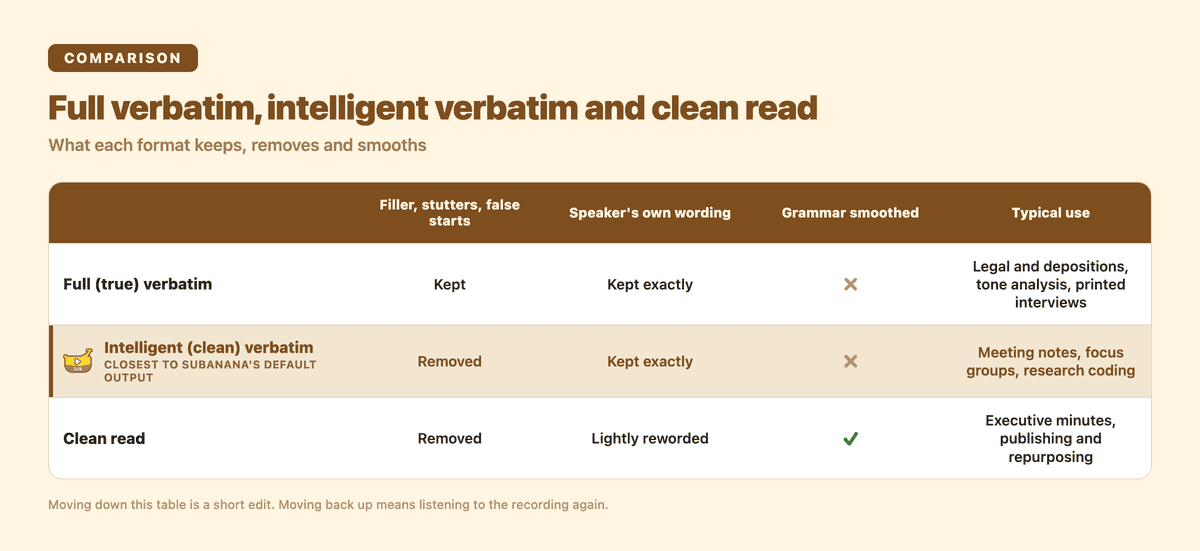
The three formats differ on exactly three things: whether the filler survives, whether the wording is the speaker's own, and whether the grammar gets smoothed.
Then match that to the job in front of you:
| Use case | Recommended format | Why |
|---|---|---|
| Legal / deposition | Full verbatim | The record must capture every word and how it was said |
| Qualitative research (tone analysis) | Full verbatim | Hesitations and pauses are data |
| Qualitative research (coding content) | Intelligent verbatim | Standard style; readable but faithful |
| Meeting minutes | Intelligent verbatim / clean read | Decisions and actions matter, not the "ums" |
| Focus groups | Intelligent verbatim | Readable, per-speaker, faithful to wording |
| Podcast show notes / content | Clean read | Reads like prose for publishing |
| Printed interview | Full verbatim | Exact wording is the deliverable |
One thing worth deciding up front: moving down this list is cheap and moving up it is expensive. Turning a clean verbatim transcript into a clean read is twenty minutes of tidying. Turning it back into full verbatim means listening to the recording again, because the filler you would need is no longer in the text.
Common mistakes when requesting a transcript format
Asking for "verbatim" without specifying which kind. Vendors and AI tools don't agree on what the bare word "verbatim" means — some default to full verbatim, others to intelligent verbatim. Name the specific format (full verbatim, intelligent/clean verbatim, or clean read) rather than the single word, so the person or tool doing the work doesn't have to guess.
Choosing full verbatim by default "to be safe." It feels like the more complete option, but it's the most expensive to produce and the hardest to read back later. If nobody on the team actually needs the filler words and false starts, full verbatim just adds noise to search and review. Default to intelligent verbatim unless tone or hesitation is itself the thing being analyzed.
Mixing formats within one project. A transcript where some passages are lightly tidied and others are left as full verbatim reads as inconsistent and makes it harder to search or quote later. Pick one format for the whole document, and if a section genuinely needs the other treatment (a deposition quote inside an otherwise clean-read report, for example), mark it explicitly rather than leaving the shift unlabeled.
Not deciding the format before the meeting or interview. Every downstream cleanup (removing filler, smoothing grammar) is a one-way trip in the sense that going back the other direction means re-listening to the source audio. Decide the target format before recording, or at minimum before ordering the transcript, rather than requesting a clean read now and full verbatim later from the same session.
How this works with AI transcription
Most AI transcription tools, Subanana included, produce a clean, readable transcript by default, closer to intelligent verbatim than to full verbatim. In Subanana's transcript mode the AI removes filler words and tidies the text, and punctuation and paragraph breaks are restored automatically. That formatting always runs on a transcript; there is no style setting to switch between verbatim and clean read, and no control to turn the punctuation and paragraphing on or off.
The practical workflow:
- Upload your audio or video, or paste a public link.
- Set the source language (Subanana supports 95+ languages) and the number of speakers.
- Generate the transcript. It comes back in one clean, readable style with speaker labels.
- In the editor, take it the rest of the way by hand. The transcript is normal editable text, so smoothing a passage into a clean read for publishing is ordinary editing work rather than a setting you flip.
- Export, or choose meeting mode at project creation if you want a summary of key discussion points, decisions, and action items alongside the transcript.
So the realistic split is this. Clean verbatim is what you get; clean read is a short edit away; full verbatim is a different deliverable and is best commissioned as one, because reconstructing every "um" from a cleaned draft means working through the audio line by line. For everything short of that, one audio transcription run covers both the readable record and the published version. If you also need to know who said what, see our guide on speaker labels and diarization.
Frequently asked questions
Is intelligent verbatim the same as clean verbatim?
Yes. "Intelligent verbatim," "clean verbatim," and "smart verbatim" all refer to the same style: filler words, false starts, and stutters removed, while the speaker's actual words and meaning stay intact. Different vendors just use different names for it.
What is the difference between clean verbatim and clean read?
Clean verbatim removes the noise (filler, stutters, false starts) but keeps the speaker's exact wording. Clean read goes a little further and lightly smooths grammar and phrasing so the transcript reads like prepared text. Clean read is more polished; clean verbatim is more faithful to how the person actually phrased things.
Which format do I need for qualitative research?
It depends on your analysis. If you are studying how people speak, including pauses, hesitation and emotion, use full verbatim. If you are coding what they said, intelligent verbatim is the standard and is far easier to read and code.
Does AI transcription give me verbatim or clean text?
Clean text. Most AI tools, Subanana included, output a clean, readable style closer to intelligent verbatim, with filler words removed and the text tidied.
How do I get a full-verbatim transcript if the AI has already cleaned it?
You go back to the audio. The filler, stutters and false starts a full-verbatim record needs were dropped before the text reached you, so restoring them is a re-listening job, not an undo. If full verbatim is a regular requirement (court work, discourse analysis), commission it as full verbatim from the start rather than repairing a cleaned draft.