
If you're searching for a Grain alternative, you're usually hitting one of three walls: your sales team has expanded into non-English markets (LATAM, Asia-Pacific, Europe) and Grain's English-primary recognizer drops accuracy; you're running multilingual customer events and need live audience captions Grain doesn't ship; or you've outgrown the per-seat pricing model and want a workspace-based plan that doesn't punish team growth.
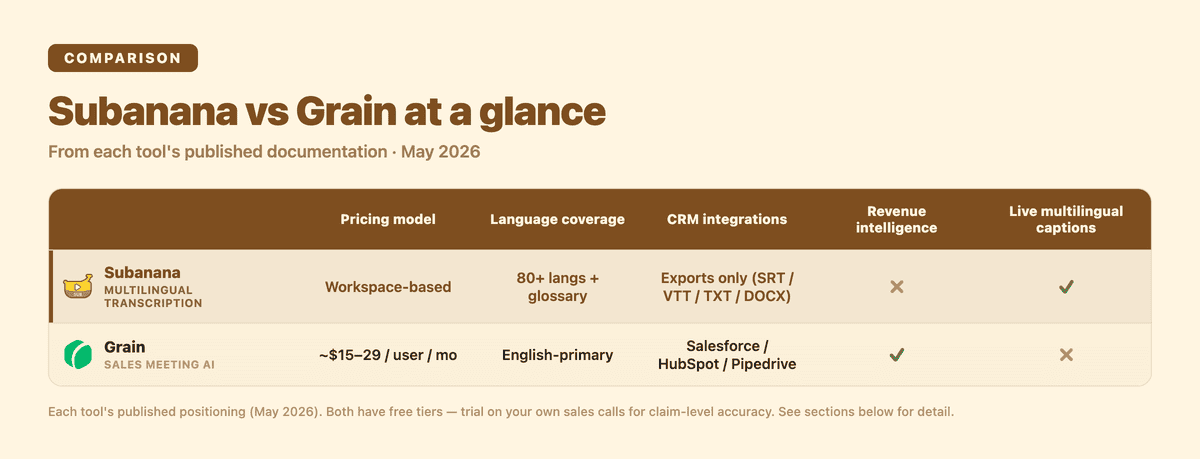
Disclosure: I run Subanana. This comparison cites only verified facts from each tool's published documentation (Grain's pricing, features, and integration pages, plus Subanana's internal product documentation), pulled May 2026. No fabricated head-to-head benchmarks; both have free tiers, so test on your own sales calls if you want claim-level accuracy comparisons.
TL;DR
- Pick Grain if you're a sales team in the US-vendor ecosystem (Salesforce, HubSpot, Pipedrive), English-primary calls, and value revenue-intelligence features (deal health scoring, coaching scorecards, conversation analytics) over multilingual coverage.
- Pick Subanana if you need non-English or mixed-language transcription across 95+ languages, glossary-driven proper-noun accuracy for branded sales conversations, multi-LLM summary control, workspace pricing, or live multilingual customer events where the audience needs captions in a different language than the speaker's.
- Honest middle ground: for a US sales team doing English-only Zoom calls hooked to Salesforce, Grain is the better tool — the revenue-intelligence layer is real product depth Subanana doesn't claim. For a globally distributed sales team selling into multiple language markets, or a team that needs glossary-locked product names on every call, Subanana fits closer. Mid-market teams with both needs end up running both side-by-side for a quarter and choosing one.
Pricing
Grain's pricing page (May 2026) lists four public tiers:
| Plan | Monthly price | Recording hours | AI features | Notes |
|---|---|---|---|---|
| Free | $0 | Limited / month | Basic AI notes | Solo trial |
| Starter | ~$15 / user / month (billed annually) | Unlimited | Standard AI + CRM sync | Solo to small team |
| Business | ~$29 / user / month (billed annually) | Unlimited | Advanced AI + coaching + scorecards | Sales-team focus |
| Enterprise | Custom | Unlimited | Custom AI + SSO + admin | Large orgs |
Subanana uses workspace-based pricing — a single workspace fee covers the whole team's usage rather than per-seat billing. For a 10-person sales team comparing comparable AI-summary tiers, that math usually lands meaningfully below 10 × per-seat pricing. Check the live pricing page for current tiers — we update them more often than the blog's cache refresh.
Grain's per-seat model is straightforward and predictable for growing sales teams that hire one seat at a time. Subanana's workspace model wins economically as the team grows past ~5 seats with shared recording access.
Language support
Grain's supported languages article lists English as the primary recognition language, with support for additional European languages (Spanish, French, German, Italian, Portuguese, Dutch) and some Asian languages (Japanese, Korean, Mandarin). Per-language accuracy isn't published.
Subanana covers 95+ languages via multi-model evaluation with best-per-language routing. Specifically relevant for sales teams selling across multiple language markets:
- Glossary across all languages — pre-load product names, competitor names, and industry-specific vocabulary so the recognizer treats them as expected vocabulary on every call. The single biggest review-time saver on branded sales conversations.
- 95+ source languages first-class supported — all major European languages plus Mandarin, Japanese, Korean, Vietnamese, Thai, Cantonese, and many more.
- Mixed-language audio — non-English recognition is stronger than English-primary tools, with glossary boosting for proper nouns. No need to commit to one dominant language at setup time.
For sales teams whose pipeline includes non-English-speaking prospects or proper-noun-heavy product positioning, the language-coverage gap — and Subanana’s cross-language glossary for proper nouns — is the most likely reason to add (or switch to) Subanana.
CRM integrations and sales workflow
Grain's integrations page shows tight Salesforce, HubSpot, and Pipedrive integration with deal-level call attachment, automatic CRM field updates, and conversation-to-CRM pipeline workflows. Plus Slack, Notion, Linear, and Zapier for downstream automation. This is genuinely deep — Grain's CRM integration depth is one of its strongest market positions.
Subanana's integration story is narrower today. Direct downloads of SRT / VTT / TXT / DOCX, with extensive support for the editing-software side (Premiere Pro, Final Cut Pro, DaVinci Resolve via SRT import). Subanana does not currently offer a public Zapier app, native Salesforce / HubSpot / Pipedrive integration, Slack/Notion push-out, or CRM-deal-level webhook. For sales-team-as-primary-buyer use cases, this is a real Subanana weakness.
The corresponding Subanana strength is editorial control: transcripts and summaries stay in the workspace where you can correct speaker labels, fix industry-specific terminology, and rewrite sentence-level output before exporting. Grain optimizes for automation; Subanana optimizes for editorial accuracy. The "right" choice depends on whether your team values automation throughput or transcript precision.
AI summary, coaching, and revenue intelligence
Grain's standout product depth is the revenue-intelligence layer: AI moments tagging key call segments, deal health scoring based on conversation signals, coaching scorecards comparing rep performance, and conversation analytics across team-wide call data. For sales managers building a coaching practice, this layer alone often justifies Grain's pricing.
Subanana doesn't offer a comparable revenue-intelligence layer today. What Subanana does on the AI summary side is multi-LLM routing: multiple frontier models (GPT, Gemini, DeepSeek, Grok, Qwen families — the lineup expands as new models ship) with per-meeting model selection. This matters because summary quality is more a "taste" problem than a "correctness" problem — the best model for short standup summaries is often not the best model for client-call faithfulness or non-English summarization.
For a sales team that has tested several AI tools and found that one model writes better discovery-call summaries while another nails the next-steps section, Subanana lets you pick per-meeting; Grain locks you to whatever it ships with.
Where Grain genuinely wins
A short list, framed honestly:
- Revenue intelligence depth — deal health scoring, AI moments tagging, coaching scorecards. This is real product surface Subanana doesn't claim. A sales-coaching-driven org gets value here that no general transcription tool offers.
- CRM integration depth is best-in-class for Salesforce / HubSpot / Pipedrive. Deal-level call attachment, automatic field updates, pipeline-driven workflows.
- English sales-call accuracy is mature and battle-tested across years of US-market deployment.
- Established US-market brand in the sales-tools category. Buyers comparing 5 tools recognize Grain immediately.
- Sales-team workflow design — playlists, snippets, shareable highlight reels — these are sales-specific features Subanana doesn't have.
If your team is US sales running on English Zoom + Salesforce + active coaching practice, Grain is likely the better tool.
Where Subanana loses
Equally honest:
- No CRM-native integrations. No native Salesforce, HubSpot, Pipedrive integration; no Zapier app; no Slack/Notion push-out. Outbound flows are export-and-paste rather than push-and-forget.
- No revenue intelligence layer. No deal health scoring, no AI moments, no coaching scorecards. Subanana is a transcription + summary + caption tool — not a sales operations platform.
- Smaller brand recognition in the US sales-tools category. A buyer comparing meeting AI options may not encounter Subanana in their first round of research.
How to decide
Four reader profiles:
- US sales team, English calls, Salesforce + HubSpot, building a coaching practice. → Grain. The revenue-intelligence and CRM depth justify the price.
- Globally distributed sales team selling into non-English markets, or any team with proper-noun-heavy product positioning that needs glossary support. → Subanana. Language coverage and glossary are the deciding factors; Grain's English-primary recognizer won't perform well on non-English, proper-noun-heavy pipelines here.
- Mid-market global team with both English-primary and non-English sales pipelines. → Pilot both for a quarter, segment by team. Realistic answer: many global orgs end up running Grain for the US team and a Subanana-class tool for the multilingual team.
- Sales team running live multilingual customer events (webinars, user conferences) where the audience needs captions in a different language than the speaker's. → Subanana. Grain doesn't ship live-event captioning.
Try them both
Both have free tiers; the right way to decide is to run a real customer call through each on your own audio. Specifically test:
- Your typical discovery / demo call in your team's primary language
- One sales call in a non-English language if your pipeline includes it
- One sales coaching review (extract action items, evaluate the rep's qualification questions)
Subanana trial: https://subanana.com/en. Grain trial: https://grain.com. Compare on what your reps actually say in real calls — not on a comparison post's framing.
Related reading
- Best AI meeting transcription tools 2026
- Subanana vs Tactiq (2026)
- Subanana vs Fireflies (2026)
- Subanana vs Otter (2026)
Methodology: facts in this post are sourced from Grain's published pricing page (https://grain.com/pricing) and features page (https://grain.com/), plus Subanana's internal product documentation, pulled May 2026. No fabricated head-to-head benchmarks. To run a real head-to-head, trial both tools on your own audio.