If you're searching for a Tactiq alternative, you're usually hitting one of three walls: the Chrome-tab-must-stay-open requirement breaks once you close the laptop, the AI summary model isn't tunable per meeting, or you've started running events where the audience needs live captions in a language different from the speaker's.
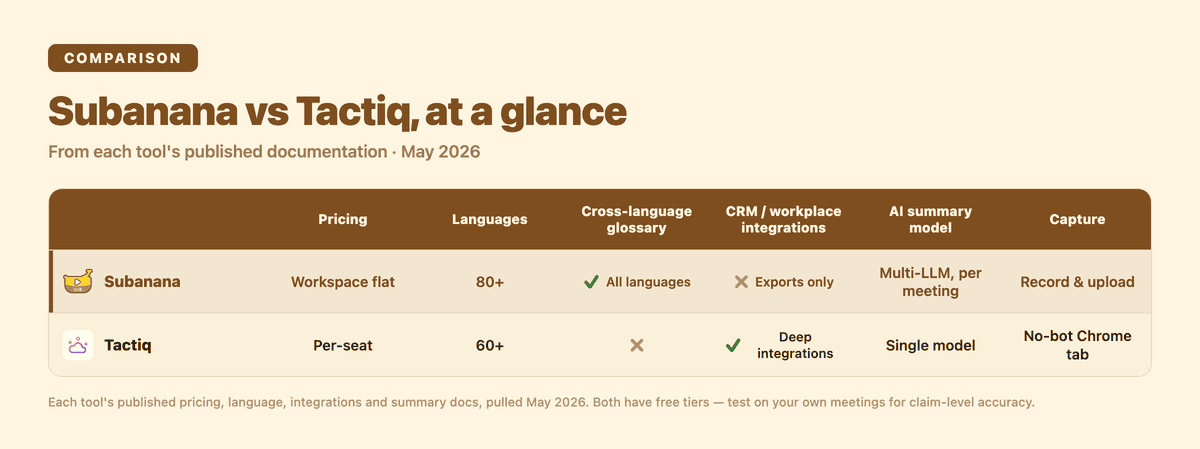
Quick-reference summary of the dimensions compared in detail below.
Disclosure: I run Subanana. This comparison cites only verified facts from each tool's published documentation (Tactiq's pricing, features, and integrations pages, plus Subanana's internal product documentation), pulled May 2026. No fabricated head-to-head benchmarks; both have free tiers, so test on your own meetings if you want claim-level accuracy comparisons.
TL;DR
- Pick Tactiq if you live inside Google Meet (or Zoom, or Teams) for English meetings, want a no-bot experience that captures audio via your browser tab, and value the existing CRM-side integrations (HubSpot, Salesforce, Notion, Slack) over deeper meeting-AI flexibility.
- Pick Subanana if you need glossary-driven proper-noun accuracy across 95+ languages, multi-LLM summary control, workspace pricing, or run live multilingual events where the audience needs captions in a different language than the speaker's.
- Honest middle ground: for an English-only solo user living in Google Meet who never records meetings, Tactiq is the simpler and arguably better choice; for multilingual workflows, branded content needing glossary support, or live multilingual events, Subanana fits closer. For mid-market sales teams that need both recording and CRM deep-integration, Fireflies or Gong are worth a look as a third option.
Pricing
Tactiq's pricing page (May 2026) lists three public tiers:
| Plan | Monthly price | Meetings | AI credits | Notes |
|---|---|---|---|---|
| Free | $0 | 10 transcripts / month | Limited | Personal use |
| Pro | ~$12 / user / month (billed annually) | Unlimited | Standard AI quota | Solo professional |
| Team | ~$20 / user / month (billed annually) | Unlimited | Higher AI quota + admin | Small teams |
| Enterprise | Custom | Unlimited | Custom | SSO, custom AI |
Subanana uses workspace-based pricing — a single workspace fee covers the whole team's usage rather than per-seat billing. For a team of 5 on a comparable meeting-AI tier, that math typically lands materially below 5 × per-user pricing. See the live pricing page for the current tiers (we change them more often than blog cache refresh cycles).
Tactiq's per-seat model is cleaner for solo professionals; Subanana's workspace model tends to win for teams of 3+ that share recording / summary access.
Language support
Tactiq's supported languages article lists 60+ languages including Cantonese, Mandarin, Japanese, Korean, Vietnamese, Thai, and major European languages. The list is broad; per-language accuracy isn't published, and the recognizer choice isn't disclosed.
Subanana covers 95+ languages via multi-model evaluation with best-per-language routing under the hood. The notable practical difference: Subanana's glossary feature works across all 95+ supported languages, letting teams pre-load product names, people's names, and technical vocabulary so the recognizer treats them as expected vocabulary on every call. Tactiq's documentation doesn't describe a comparable cross-language glossary mechanism — branded terms get phonetically guessed each meeting.
For mixed-language audio (e.g. a Japanese-English design review, a Spanish-English sales call), Subanana applies stronger non-English recognition with glossary boosting for proper nouns; Tactiq's behavior depends on which language is set as primary and tends to misrecognize the secondary language.
Integrations and workflow
Tactiq's integrations page shows tight Google Meet, Zoom, Microsoft Teams native capture, plus push-out to HubSpot, Salesforce, Notion, Slack, Confluence, and Zapier. This is a strong CRM + workplace-stack story — particularly for sales teams in the US-vendor ecosystem.
Subanana's integration story is narrower today. Direct downloads of SRT / VTT / TXT / DOCX, with extensive support for the editing-software side (Premiere Pro, Final Cut Pro, DaVinci Resolve via SRT import). Subanana does not currently offer a public Zapier app, native Salesforce integration, Slack/Notion push-out, or HubSpot CRM hook. If your workflow is anchored to those tools, Tactiq has more out-of-the-box wiring.
This is a real Subanana weakness for stack-heavy buyers. The corresponding Subanana strength is that the transcript and summary stay in the workspace where you can edit them in detail (speaker labels, glossary corrections, sentence-level rewording) before exporting — Tactiq's strength is automation, Subanana's is editorial control.
AI summary & post-meeting workflow
Tactiq generates AI summaries via a single underlying model with prompt customization options on Pro/Team tiers. The model choice isn't user-tunable per meeting.
Subanana's differentiator on the summary side: multi-LLM routing. The platform supports multiple frontier models (including GPT, Gemini, DeepSeek, Grok, Qwen families — the lineup expands as new models ship) and lets you pick the model per meeting. This matters because summary quality is a taste problem more than a correctness problem — the best model for short standups is often not the best model for client-call faithfulness or non-English summarization. Subanana exposes that choice; most competitors don't.
For a team that has tested several AI tools and found that one model writes better client-call summaries while another nails action-item extraction, Subanana lets you pick per meeting; Tactiq locks you to whatever it ships with this quarter.
Where Tactiq genuinely wins
A short list, framed honestly:
- No-bot Chrome capture is the most elegant capture method for the meetings you attend live. Tactiq doesn't show up in the participant list — many people find this less awkward than a meeting-bot named "Otter / Fireflies / Subanana Notetaker" being visible to clients.
- CRM + workplace integrations are deeper out of the box. Sales teams on Salesforce or HubSpot get value within the first hour of installation.
- Pricing per-seat is predictable for individuals and small teams that don't need shared workspaces — easier to expense, easier to onboard one person at a time.
- Free tier is meaningful at 10 meetings/month — covers many independent professionals' workloads.
If the above describes you well, Tactiq is the right pick.
Where Subanana loses
Equally honest:
- Fewer pre-built integrations. No native Salesforce, no public Zapier app, no HubSpot CRM webhook, no Slack/Notion push-out today. Outbound flows are export-and-paste rather than push-and-forget.
- Browser-tab-must-be-open isn't our requirement, but our recording-and-upload model has its own friction. You record the meeting separately (Zoom cloud / local recording / whatever your stack uses) and upload to Subanana after. The trade is: no live-capture limitation, but an extra step in the flow.
- Brand recognition outside HK / Greater China is smaller. A new buyer comparing five tools may not have heard of us — Tactiq's name carries more weight in the US sales-tool ecosystem.
How to decide
Three reader profiles:
- Solo professional, English-only Google Meet user, doesn't need recording archive. → Tactiq. Chrome-extension capture + free tier + no recording management = simplest setup.
- Sales team on Salesforce/HubSpot, English meetings, 5–20 seats. → Tactiq for the integration depth, unless workspace pricing economics flip the decision at higher seat counts.
- Multilingual team, branded content needing glossary support, or running live multilingual events with audience-facing captions. → Subanana. Glossary across 95+ languages, multi-LLM summary selection, workspace pricing, and (for live multilingual events specifically) live-caption with auto-detect + mid-sentence switching are direct fits.
Try them both
Both have free tiers; the right way to decide is to run one real meeting through each on your own audio and look at the output. Specifically test:
- Your typical 1-on-1 client call recorded in your standard language
- Your typical internal team standup
- One meeting in a non-English or mixed-language scenario if applicable to you
Subanana trial: https://subanana.com/en. Tactiq trial: https://tactiq.io. Run both, compare on what your team actually says — not on what a comparison post claims.
Related reading
- Best AI meeting transcription tools 2026
- Subanana vs Otter (2026)
- Best Otter alternatives 2026
- Subanana vs Fireflies (2026)
Methodology: facts in this post are sourced from Tactiq's published pricing page (https://tactiq.io/pricing), features page (https://tactiq.io/features), and supported-languages help article (https://help.tactiq.io/en/), plus Subanana's internal product documentation, pulled May 2026. No fabricated head-to-head benchmarks. To run a real head-to-head, trial both tools on your own audio.