
Rev has been one of the most established names in transcription since well before AI became the default. Its flagship is human-verified transcription — real people typing and reviewing transcripts — with AI transcription added as a faster, cheaper option. Rev markets high accuracy across both tiers and publishes head-to-head benchmarks against Google, Otter, Amazon, and Microsoft on its AI transcription page.
If you're searching for a Rev alternative, you're usually hitting one of three gaps: multilingual coverage — non-English, code-switched, or Asian-language audio that Rev's 37-language list doesn't deeply address — the per-seat pricing getting expensive for teams that don't need 5,000-10,000 minutes per seat, or you need live multilingual event captioning that Rev doesn't offer.
Subanana plays in that narrower transcription + live-caption space, with a specific strength in harder real-world audio: mixed-language and code-switched recordings, and Asian languages (Mandarin, Japanese, Korean, and Cantonese among them). Different categories — here's how the two products line up.
Disclosure: I run Subanana. This post compares each tool using its own published documentation — pricing pages, features pages — pulled in May 2026. No fabricated head-to-head benchmark; Rev publishes their own benchmarks and you can validate them on your own audio.
Roundup context: Best AI Meeting Transcription Tools 2026 → — this post is the Rev deep dive.
TL;DR
- Pick Rev if your work is English-heavy or English+Spanish, you need human-verified transcription for accuracy-critical projects (legal, broadcast, healthcare), HIPAA / CJIS compliance is required, or you have very high monthly transcription volume per user (5,000-10,000 min/seat).
- Pick Subanana if a meaningful portion of your work is multilingual, code-switched, or Asian-language audio, you run live multilingual events with audience-facing captions, you want user-selectable LLMs for meeting summaries, or you're a team of 3+ where per-workspace pricing scales better.
- The shape of the choice: Rev is the enterprise incumbent — human safety net, broad compliance posture, high per-seat minutes. Subanana is the multilingual + live-event specialist. If your job is "transcribe English audio at scale, sometimes with human review," Rev. If your job involves mixed-language or code-switched content, or live captioning for events, Subanana.
Pricing snapshot (May 2026)
Rev (per seat, USD)
| Plan | Monthly | Annual (effective /mo) | AI minutes/mo | Languages | Multi-file | Max seats |
|---|---|---|---|---|---|---|
| Free | $0 | — | 45 min | English only | 5 files | 1 |
| Essentials | $29.99 | $25.49 | 5,000 min/seat | English + Spanish | 10 files | 3 |
| Pro | $59.99 | $47.99 | 10,000 min/seat | 37+ languages (incl. Spanglish) | 50 files | 5 |
| Unlimited | Custom | Custom | Unlimited | All | Up to 500 files | Unlimited |
Pay-as-you-go AI: $0.25/min. Human transcription: pay-per-minute (rates not published on the pricing page; subscriber discounts of 3-15% depending on tier). Unlimited tier adds CJIS + HIPAA compliance.
Subanana (per workspace, USD)
| Plan | Monthly | Annual (effective /mo) | File limit | Annual minute allocation |
|---|---|---|---|---|
| Free | $0 | — | 8 hr/file, 30 GB (first 15 min of each file transcribed) | — |
| Lite | $18 | $9 | 8 hr/file, 30 GB | 720 min/yr |
| Pro | $30 | $18 | 8 hr/file, 30 GB | 2,160 min/yr |
| Max | $75 | $50 | 8 hr/file, 30 GB | 7,200 min/yr |
| Business | Contact sales | Contact sales | Custom | Custom |
Per-workspace pricing. Free tier doesn't allow subtitle/transcript download; paid tiers enable downloads. Subanana minutes don't roll over across billing cycles.
The two pricing models are very different shapes:
- Rev's per-seat AI allocation is huge (5,000-10,000 min/seat/mo) — designed for users transcribing several hours daily
- Subanana's per-workspace allocation (720-7,200 min/yr) is sized for episodic professional users — meetings, podcasts, video subtitling — not industrial-scale transcription throughput
For solo high-volume English transcribers, Rev's allocation is far more generous. For teams of 3+ on moderate usage where most members aren't transcribing daily, Subanana's per-workspace price tends to be cheaper.
Where Rev wins
I'll start here because these are real strengths sourced from Rev's published pages.
1. Human-verified transcription
Rev's original flagship is human transcription — real people typing transcripts and reviewing AI output. Rev markets this tier as its highest-accuracy option. For accuracy-critical work (legal depositions, broadcast subtitling, healthcare records, regulatory filings), having a documented human path inside the same product is a real advantage. Subanana is currently AI-only. If your workflow needs human-verified output, Rev is the right tool.
2. Published AI accuracy claims with comparative benchmarks
Rev markets high AI transcription accuracy and publishes head-to-head benchmarks against Google, Otter, Amazon, and Microsoft on its AI transcription page (these are vendor self-reported, not independently audited). This kind of public, vendor-checkable claim is rare in the AI transcription category. Subanana doesn't publish per-language accuracy numbers; it benchmarks STT models and routes to the best one per source language, rather than marketing a single headline figure vs the same set of competitors. For procurement contexts where a published benchmark matters, Rev has a more polished story.
3. HIPAA + CJIS compliance at Unlimited tier
Rev's Unlimited tier includes HIPAA and CJIS (Criminal Justice Information Services) compliance. Subanana does not currently advertise HIPAA or CJIS compliance. Healthcare and law-enforcement teams should pick Rev — those are hard regulatory requirements, not preference items.
4. Very high per-seat minute allocations
Rev Essentials is 5,000 AI minutes/seat/month. Pro is 10,000. For users transcribing hours of content daily — court reporters, podcast networks, content libraries doing back-cataloguing — these allocations are far more generous than Subanana's per-cycle minute pools. Pure throughput per seat goes to Rev.
5. Multi-file batch analysis (up to 500 files)
Rev's Unlimited tier supports analysis of up to 500 files at once. For legal discovery, audit transcription, or other batch workflows that involve hundreds of files at a time, this batching capacity is purpose-built for the use case. Subanana doesn't currently advertise large-batch multi-file analysis.
6. $0.25/min pay-as-you-go AI
For ad-hoc users who don't want a subscription, Rev's $0.25/min PAYG is straightforward and low-friction. Subanana doesn't currently offer per-minute pay-as-you-go on AI transcription (the model is per-workspace subscription with annual minute allocation). For someone with 30 minutes of audio to transcribe once and never again, Rev's PAYG is the simpler path.
7. Brand maturity
Rev has been operating in transcription since 2010 — among the oldest brands in the category. For procurement contexts where vendor maturity matters, this is a real signal. Subanana is younger.
Where Subanana wins
1. Multilingual and code-switched audio
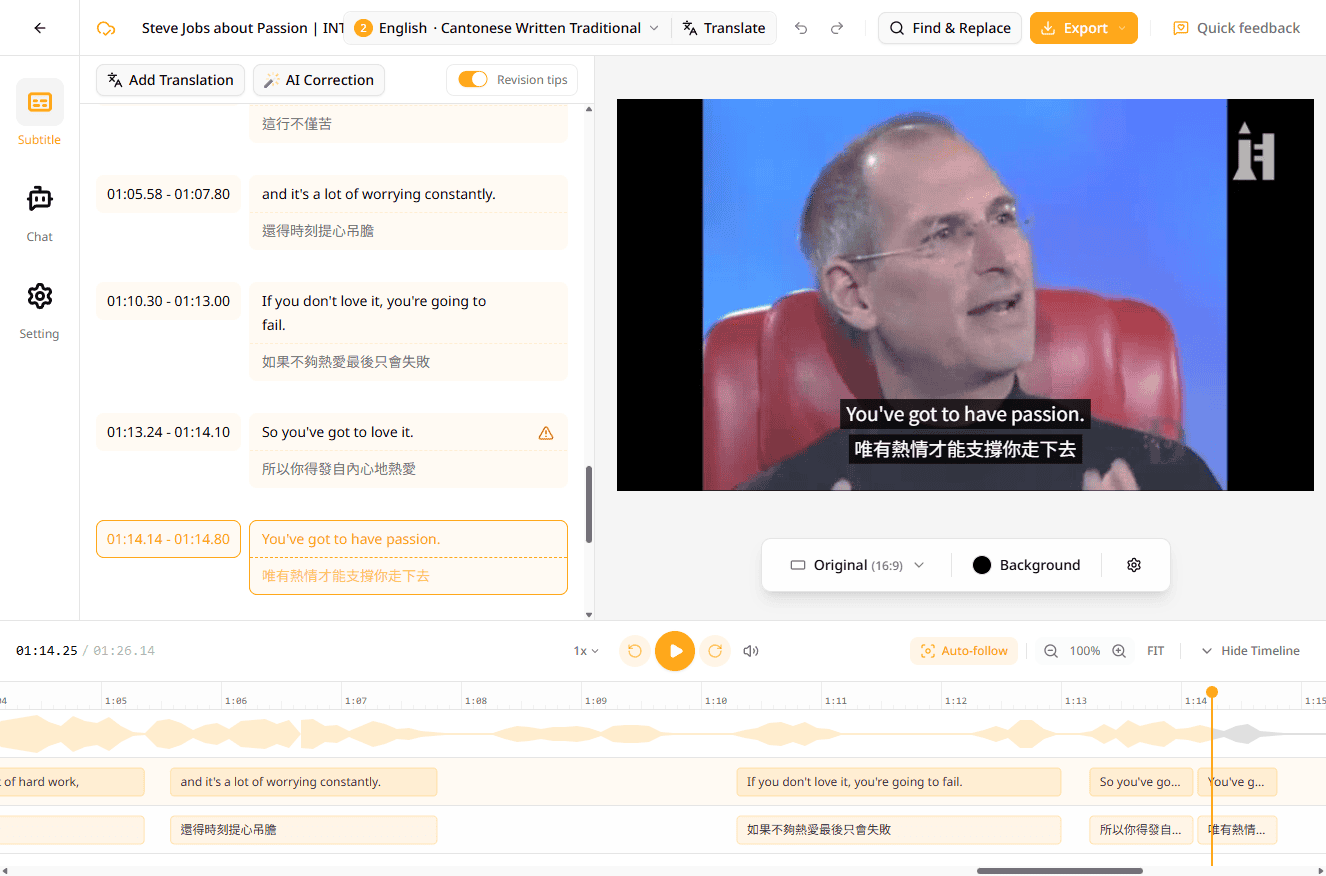
Rev's 37-language list is broad on Western languages plus Spanish, with Spanglish noted as a code-switching pair. Asian languages such as Cantonese aren't listed as supported on Rev's pricing page. For multilingual workflows that lean on those languages — Hong Kong, Taiwan, and other non-Western markets — this is the binary choice: Rev isn't a viable option; Subanana is purpose-built, benchmarking STT models and routing to the best one per source language, with Asian and code-switched audio treated as first-class.
2. Spoken-to-written conversion for languages that need it
For languages with a wide gap between how people speak and how text is written, Subanana converts colloquial speech into clean written form automatically. Cantonese is the clearest example (e.g. spoken "我哋 call 完之後 follow up" becomes written Chinese). This is unique to Subanana — Rev's AI transcription transcribes spoken speech literally, without the spoken-to-written conversion that some professional contexts require for meeting minutes, formal documentation, or subtitles.
3. Live multilingual translation with audience-facing captions
Subanana runs real-time captioning + translation for live events with an audience-facing shareable link — attendees scan a QR code and each picks one display language for the live captions on their phone — the original, or any of the up to 5 translation targets the host pre-configured for the event. Rev is a post-production transcription tool; it doesn't offer live event captioning. For conferences, university lectures, multilingual board meetings, Subanana is purpose-built.
4. User-selectable summary LLM
Subanana lets users pick which LLM writes the meeting summary — multiple frontier models supported, with the list expanding as new models ship. Rev's summary features (where applicable) use a single underlying model that's not user-selectable. For teams that have opinions about model behaviour on specific meeting types, this matters.
5. Bilingual SRT export
Subanana exports a single SRT containing both source transcription and translated text (one above the other per cue). Useful for bilingual content — one language subtitled over another. Rev's caption outputs are single-language SRT files — translation requires a separate workflow.
6. Per-workspace pricing for teams
Subanana's per-workspace pricing means a 5-person team pays the same as a 1-person team at a given tier. Rev's per-seat model adds cost per teammate, so a 10-person team on Rev Pro is ~$480/mo annual. Subanana Pro for the same team is ~$18/mo. For teams of 3+ on moderate-not-industrial usage, the math diverges fast.
7. Granular user glossary for pinning terms
Subanana lets you supply a glossary to pin brand names, product names, people, and jargon so they come out spelled the way you intend. You can keep a workspace-wide list and per-project lists, bulk-import terms from a spreadsheet (XLSX / CSV), and apply them universally or per language. Rev does offer an account-level glossary for its AI transcription, but it's a single global list entered manually and applied to every order — without Subanana's per-project scoping, per-language assignment, or bulk file import. For teams with recurring product vocabulary that differs project-to-project or language-to-language, Subanana's structure is a better fit.
Side-by-side feature table
| Feature | Rev Pro | Subanana Pro |
|---|---|---|
| Free tier | ✅ 45 min/mo (English-only) | ✅ 30 GB / 8 hr per file; first 15 min of each file transcribed |
| Transcription accuracy positioning | Markets high accuracy; human-transcription tier marketed as highest | Doesn't publish per-language numbers; benchmarks STT models and routes to the best per source language |
| Multilingual / Asian-language coverage | 37 languages (Western + Spanish; Asian languages like Cantonese not listed) | ✅ Purpose-built; best-model routing for mixed-language, code-switched, and Asian audio |
| Spoken-to-written conversion (e.g. Cantonese) | ❌ | ✅ |
| Human-verified transcription | ✅ (paid add-on) | ❌ AI-only |
| User-selectable summary LLM | ❌ | ✅ |
| User glossary / term pinning | Account-level (single global list, manual entry) | ✅ Workspace + per-project; bulk import (XLSX/CSV); per-language |
| Live multilingual captions (event-scale, audience-facing) | ❌ | ✅ |
| Bilingual SRT (single file, dual-track) | ❌ | ✅ |
| HIPAA / CJIS compliance | ✅ (Unlimited tier) | ❌ |
| Per-seat AI allocation | 10,000 min/seat/mo | n/a (per-workspace yearly pool) |
| Multi-file batch analysis | Up to 500 files (Unlimited) | Not advertised at large batch scale |
| Pay-as-you-go AI | $0.25/min | ❌ subscription model |
| Pricing model | Per seat | Per workspace |
| Storage model | Not separately published | No aggregate cap; per-file limit only (30 GB on every plan, including free; free transcribes the first 15 min of each file) |
So which should you pick?
Pick Rev if:
- Your work is English-only or English + Spanish
- Human-verified transcription is required for some of your work (legal, broadcast, regulated industries)
- HIPAA or CJIS compliance is a hard requirement
- You're a high-volume single-user transcribing many hours of audio per month
- You need pay-as-you-go AI for ad-hoc projects
- Vendor maturity is a procurement consideration
Pick Subanana if:
- A meaningful portion of your work is multilingual, code-switched, or Asian-language audio (Mandarin, Japanese, Korean, Cantonese among them)
- You need user-selectable LLMs for meeting summaries
- You run live multilingual events that need audience-facing captions
- You need bilingual SRT in a single file
- You're a team of 3+ where per-workspace pricing scales better
- You don't need human-verified transcription as a core workflow
The honest framing: Rev is the established enterprise transcription tool — strongest where human verification, regulated compliance, and high-volume English are the requirements. Subanana plays in a different shape — multilingual transcription tuned for code-switched and Asian audio, plus live event captioning for multilingual audiences. They overlap on "transcribe English audio with AI" but their best uses point at different jobs.
Enterprise option: on-premises deployment
Rev's natural buyer profile (legal, broadcast, healthcare) often comes with strict compliance requirements where cloud-routed transcription is a non-starter. Rev's Enterprise tier addresses this with its compliance certifications and HIPAA / CJIS coverage.
Subanana offers a parallel option: on-premises laptop deployment — the system runs in the enterprise's own environment without routing audio to the cloud. Pricing is separate from the standard subscription tiers and is project-based; this is positioned for organisations with both the budget and a genuine compliance requirement, not a general option. Contact Subanana for scoping.
The honest split: if the compliance requirement is satisfied by HIPAA / CJIS certification on a cloud product, Rev is the more mature option today. If the requirement is "transcription must not leave our environment," Subanana's on-prem deployment is the more direct answer.
FAQ
Is Subanana cheaper than Rev?
For solo users on light-to-moderate usage, the two free tiers are different shapes — Rev's 45-min English-only allocation vs Subanana's 15-min-per-file with no aggregate cap. For paid usage, Rev Essentials ($25.49/seat annual) is similar in price to Subanana Lite ($9/mo annual) but Rev gives 5,000 min/seat/mo — much more raw minutes per dollar for English transcription. For teams of 3+, Subanana's per-workspace pricing gets cheaper as the team grows; Rev's per-seat model scales linearly.
Does Rev support Cantonese or other Asian languages?
Rev's pricing page lists 37+ languages on the Pro tier. Cantonese isn't named in their published language coverage. Rev's strengths are English (where it markets high accuracy), Spanish, and Spanglish code-switching. For workflows leaning on Cantonese or other Asian languages, Rev isn't a viable option.
Can I get human-verified transcription from Subanana?
Not currently. Subanana is AI-only. If you need human-verified output for legal, broadcast, healthcare, or regulatory compliance, Rev's human transcription service is the right fit. For most non-compliance use cases — meeting transcripts, podcast subtitles, video subtitling — Subanana's AI transcription, with best-model routing per source language, is sufficient.
What about HIPAA?
Rev's Unlimited tier includes HIPAA compliance. Subanana doesn't currently advertise HIPAA. For healthcare workflows that involve PHI, Rev is the correct pick today.
Can Subanana handle high-volume transcription (hours per day)?
Subanana's annual minute allocations (720-7,200 min/yr depending on tier) are sized for professional episodic use rather than industrial throughput. If you're transcribing 5+ hours of audio per day (court reporting, podcast networks, content back-cataloguing), Rev's per-seat 10,000 min/mo allocation is far more generous. For typical business meetings, customer interviews, podcast episodes, video subtitling — Subanana's allocations are sufficient.
Can I migrate from Rev to Subanana?
Yes. Subanana imports audio and video files in mp4, mov, m4a, mp3, ogg, webm. Rev lets you export your transcripts and recordings, which you can re-process in Subanana.
Related comparisons
If you're comparing several transcription tools, see also:
- Subanana vs Otter — meeting-tool focus
- Subanana vs Fireflies — CRM-native vs multilingual
- Subanana vs Descript — creator studio vs transcription specialist
- Subanana vs Happy Scribe — multilingual + human option vs multilingual specialist
Try Subanana free → — no payment method required.