
If you're searching for a Supernormal alternative, you're usually hitting one of three walls: Supernormal's English-primary recognizer drops accuracy on non-English or mixed-language meetings, the bot-based capture model doesn't fit recordings or live events, or your team has outgrown per-seat pricing and wants a workspace-based plan.
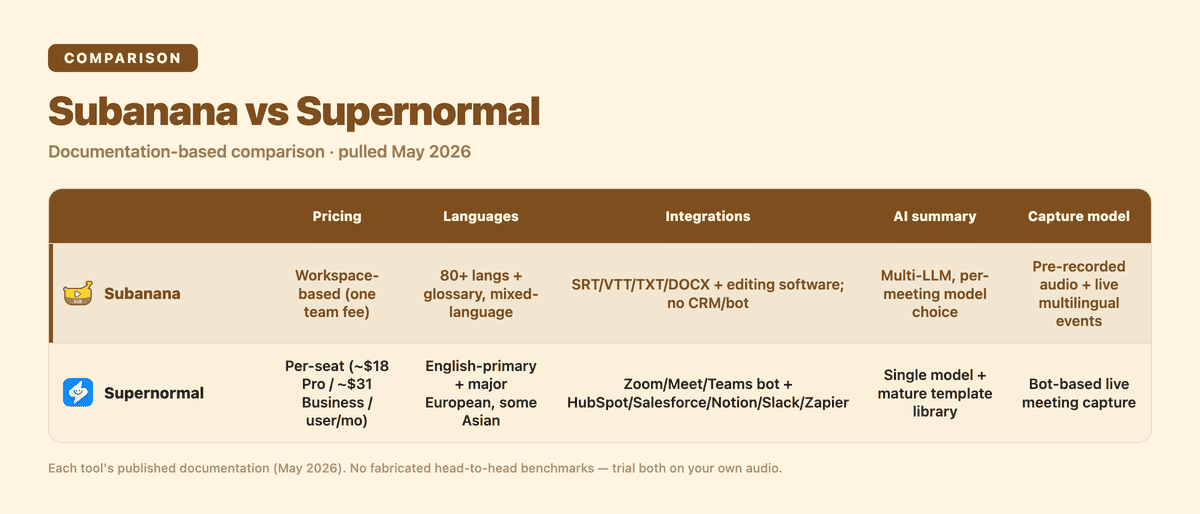
At a glance: where each tool fits, drawn from the section-by-section comparison below.
Disclosure: I run Subanana. This comparison cites only verified facts from each tool's published documentation (Supernormal's pricing, features, and integration pages, plus Subanana's internal product documentation), pulled May 2026. No fabricated head-to-head benchmarks; both have free tiers, so test on your own meetings if you want claim-level comparisons.
TL;DR
- Pick Supernormal if your team is English-primary, lives inside Zoom / Google Meet / Microsoft Teams for live meetings, and values deep CRM integrations (HubSpot, Salesforce) and bot capture in every call. Both tools ship a summary Template Library.
- Pick Subanana if you need non-English or mixed-language transcription across 95+ languages, glossary-driven proper-noun accuracy, multi-LLM summary control, workspace pricing, live multilingual customer events, or processing of pre-recorded audio (not just live meetings).
- Honest middle ground: for an English knowledge-worker team living in the US-vendor stack, Supernormal is mature and well-shaped. For multilingual teams, branded content workflows that need glossary-locked proper nouns, or teams that want LLM-per-meeting control, Subanana fits closer. Many teams use Supernormal for English Zoom calls and a Subanana-class tool for non-English or branded content — neither replaces the other.
Pricing
Supernormal's pricing page (May 2026) lists three public tiers plus Enterprise:
| Plan | Monthly price | Notes |
|---|---|---|
| Free | $0 | Limited meetings, basic AI |
| Pro | ~$18 / user / month (billed annually) | Unlimited meetings, standard AI |
| Business | ~$31 / user / month (billed annually) | Advanced AI, CRM integrations, admin |
| Enterprise | Custom | SSO, advanced security, custom AI |
Subanana uses workspace-based pricing — one workspace fee covers the whole team rather than per-seat billing. For a 10-person team, workspace pricing usually lands meaningfully below 10 × per-seat. See live pricing on subanana.com.
Supernormal's per-seat model is predictable for individual professionals and small teams scaling one hire at a time. Subanana's workspace model wins for teams past ~5 seats where many people need access but only some process recordings.
Language support
Supernormal's supported languages is English-primary with additional support for major European languages (Spanish, French, German, Italian, Portuguese) and some Asian languages (Japanese, Korean, Chinese). Per-language accuracy isn't published.
Subanana covers 95+ languages via multi-model evaluation with best-per-language routing. Specifically relevant differentiators:
- Glossary across all languages — pre-load proper nouns, product names, and technical vocabulary so the recognizer treats them as expected vocabulary. The single biggest review-time saver on branded meetings.
- 95+ source languages first-class supported — all major European languages plus Mandarin, Japanese, Korean, Vietnamese, Thai, Cantonese, and many more.
- Mixed-language audio — non-English recognition is stronger than English-primary tools, with glossary boosting for proper nouns.
For teams with non-English meeting workflows, the language coverage difference is the most likely reason to add or switch.
Integrations and workflow
Supernormal's integrations page shows tight Zoom, Google Meet, and Microsoft Teams native bot capture, plus push-out to HubSpot, Salesforce, Notion, Slack, Google Docs, Linear, and Zapier. The CRM and PM-tool integration depth is genuinely strong — Supernormal positions itself as the meeting layer of the modern productivity stack.
Subanana's integration story is narrower. Direct downloads of SRT / VTT / TXT / DOCX, with extensive editing-software support (Premiere Pro, Final Cut Pro, DaVinci Resolve via SRT import). Subanana does have a meeting bot for Google Meet and Microsoft Teams — it auto-joins via your connected calendar, records the meeting, and creates a project after the meeting ends, then transcribes and summarizes it like an uploaded file (post-production, not live captioning). But it does not currently offer a public Zapier app, native Salesforce / HubSpot integration, Slack/Notion push-out, or a Zoom bot — Zoom is captured by Subanana's Chrome extension instead. For meeting-workflow-anchored use cases — especially teams wanting a bot in every call, or tight CRM push-out — this is a real Subanana weakness.
The corresponding Subanana strength: the transcript-and-summary artifact is editable in detail (speaker labels, glossary corrections, sentence-level rewording) before export. Supernormal optimizes for automation throughput; Subanana optimizes for editorial accuracy and language coverage.
AI summary & post-meeting workflow
Supernormal generates AI summaries via a single underlying model with prompt customization and template libraries on Pro/Business tiers. The summary templates cover many common meeting types (1:1, sales call, customer interview, design review). Model choice isn't user-tunable per meeting.
Subanana's differentiator: multi-LLM routing. Multiple frontier models (GPT, Gemini, DeepSeek, Grok, Qwen families — the lineup expands as new models ship) with per-meeting model selection. Summary quality is more a "taste" problem than a "correctness" problem — the best model for short standups isn't the best for client-call faithfulness or non-English summarization. Subanana exposes that choice.
For teams that have tested several AI tools and found different models excel at different summary jobs, Subanana lets you pick per meeting. Supernormal locks you to whatever it ships with.
Where Supernormal genuinely wins
A short list, framed honestly:
- Meeting-summary template library covering many common meeting types -- though Subanana ships 30+ built-in summary templates of its own.
- CRM + PM-tool integration depth with Salesforce, HubSpot, Notion, Linear, Google Docs.
- English meeting accuracy is mature across years of US-market deployment.
- Established US-market brand recognition in the meeting-AI category.
- Bot-based capture is the right model for teams that want zero-config recording on every meeting.
If your team fits this profile, Supernormal is the right pick.
Where Subanana loses
Equally honest:
- Fewer pre-built integrations. No native Salesforce / HubSpot, no public Zapier app, no Slack/Notion push-out, and no Zoom bot. (Subanana does ship a Google Meet / Microsoft Teams bot, but it's post-production — it records and transcribes after the meeting ends, not live. Zoom is captured by Subanana's Chrome extension instead.)
- A younger summary-template library. Subanana's Template Library ships 30+ built-in summary templates (Meeting, Speech, Business, Medical, Legal, Creator) applied one-click, plus custom ones built with "Generate with AI" -- fewer production years behind it than Supernormal's, but no longer a missing feature.
- Smaller brand recognition outside HK / Greater China. A buyer comparing five tools may not encounter us in initial research.
How to decide
Three reader profiles:
- English knowledge-worker team in US-vendor stack (Salesforce / HubSpot / Notion), live meetings only. → Supernormal. Integration depth and bot capture fit the use case; both tools ship a summary Template Library.
- Multilingual team, mixed-language meetings, branded content workflows needing glossary support, or pre-recorded audio processing. → Subanana. Language coverage and glossary are the deciding factors.
- Team running live multilingual events (webinars, conferences) with audience-facing captions. → Subanana. Supernormal doesn't ship live-event captioning.
Try them both
Both have free tiers. Test on your own audio:
- A typical 1:1 in your team's primary language
- A typical client / customer call
- One non-English meeting if applicable
Subanana trial: https://subanana.com/en. Supernormal trial: https://supernormal.com.
Related reading
- Best AI meeting transcription tools 2026
- Subanana vs Tactiq (2026)
- Subanana vs Grain (2026)
- Subanana vs Fellow (2026)
Methodology: facts in this post are sourced from Supernormal's published pricing page (https://supernormal.com/pricing) and features page (https://supernormal.com), plus Subanana's internal product documentation, pulled May 2026. No fabricated head-to-head benchmarks. To run a real head-to-head, trial both tools on your own audio.