
If you're searching for a Fellow alternative, you're usually hitting one of three walls: Fellow's English-primary AI doesn't perform on non-English meetings, the agenda-and-notes workflow doesn't include actual audio transcription so you're still typing or copying notes manually, or you've started running live multilingual events where the audience needs captions Fellow doesn't ship.
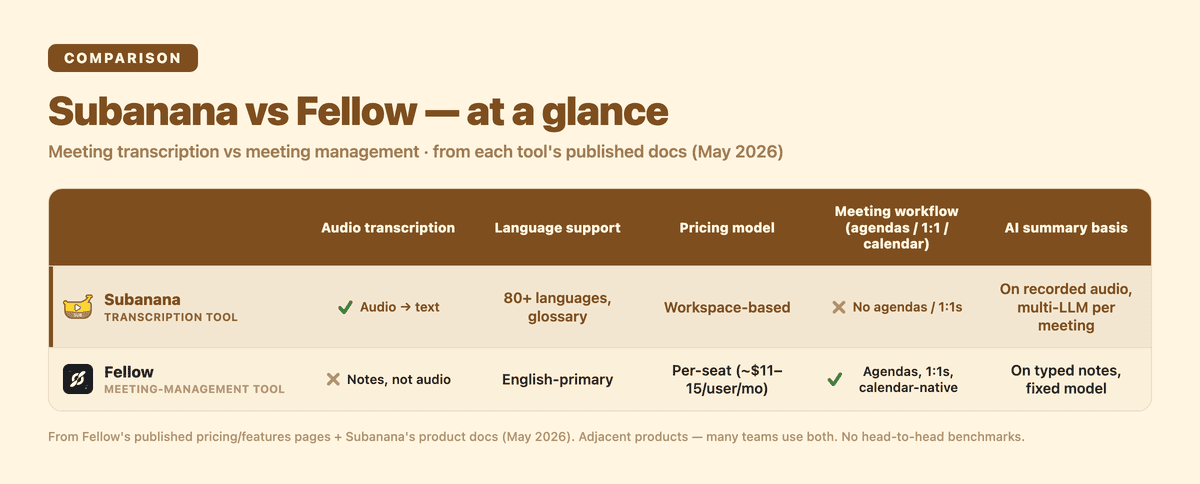
At a glance: Fellow is meeting-management (agendas, 1:1s, calendar); Subanana is meeting transcription (audio → text → AI summary), with 95+-language support. The dimensions below are detailed section by section.
Disclosure: I run Subanana. This comparison cites only verified facts from each tool's published documentation (Fellow's pricing, features, and integration pages, plus Subanana's internal product documentation), pulled May 2026. No fabricated head-to-head benchmarks; both have free tiers, so test on your own meetings if you want claim-level comparisons.
Note up front: Fellow and Subanana solve adjacent but distinct problems. Fellow is meeting management (agendas, notes, action items, recurring 1:1s). Subanana is meeting transcription (audio → text → AI summary → captions). Many teams end up using both — the comparison below is for readers deciding between them, not necessarily replacing one with the other.
TL;DR
- Pick Fellow if your team's pain point is "we don't have good meeting agendas / structure / action-item tracking," your meetings are English-primary, and you don't need actual audio-to-text transcription. Fellow's agenda templates, collaborative notes, and 1:1 management workflow are genuinely good product depth.
- Pick Subanana if your team's pain point is "we need accurate transcription of meetings (including non-English or mixed-language meetings, and proper-noun-heavy content that needs glossary support), AI-generated summaries, and exportable transcripts." Subanana is a transcription tool; Fellow is a meeting-structure tool.
- Honest middle ground: many teams use both — Fellow for agenda-driven team rituals, a transcription tool for client calls and external meetings. If you can only pick one, pick based on whether your bigger problem is "we don't run meetings well" (Fellow) or "we lose information from meetings" (Subanana).
Pricing
Fellow's pricing page (May 2026) lists three public tiers plus Enterprise:
| Plan | Monthly price | Notes |
|---|---|---|
| Free | $0 | Limited users, basic features |
| Pro | ~$11 / user / month (billed annually) | Standard AI, unlimited 1:1s |
| Business | ~$15 / user / month (billed annually) | Advanced AI, admin, integrations |
| Enterprise | Custom | SSO, advanced security |
Subanana uses workspace-based pricing — a single workspace fee rather than per-seat. For a 10-person team, workspace pricing usually lands meaningfully below 10 × per-seat. Live pricing on subanana.com.
The two pricing models don't directly compete because the product surface is different. Fellow's per-seat model fits team-meeting use cases where every person on the team needs an account. Subanana's workspace model fits transcription use cases where a smaller group needs the tool but processes many recordings.
Language support
Fellow's product is English-primary. AI features (summary, action items extraction) are tuned for English. Fellow does work with non-English text input (you can write meeting notes in any language Unicode supports), but the AI layer's output quality drops outside English.
Subanana covers 95+ languages via multi-model evaluation with best-per-language routing. For non-English meeting documentation:
- Glossary across all languages — pre-load proper nouns, product names, and technical vocabulary so the recognizer treats them as expected vocabulary, eliminating the manual review pass on branded meetings.
- 95+ source languages first-class supported — all major European languages plus Mandarin, Japanese, Korean, Vietnamese, Thai, Cantonese, and many more, with best-per-language model routing.
- Mixed-language audio — non-English recognition is stronger than English-primary tools, with glossary boosting for proper nouns.
If your team's meetings are English-only, this difference doesn't matter. If they aren't, this is the deciding factor.
Integrations and workflow
Fellow's integrations page shows tight Google Calendar, Outlook Calendar, Slack, Notion, Jira, Asana, HubSpot, Salesforce, and Microsoft Teams integrations. The integration story is built around the meeting lifecycle: agenda before, notes during, action items after — all synced to the tools your team already uses.
Subanana's integration story is narrower. Direct downloads of SRT / VTT / TXT / DOCX, with extensive editing-software support (Premiere Pro, Final Cut Pro, DaVinci Resolve via SRT import). Subanana does not currently offer a public Zapier app, native Salesforce / HubSpot integration, Slack/Notion push-out, or calendar-side workflow hooks. For meeting-management workflow use cases, this is a real Subanana weakness.
The corresponding Subanana strength is the transcription pipeline itself — what comes out of Subanana is editable text with timecodes, exportable in formats other tools can consume. Fellow's strength is the workflow around meetings; Subanana's strength is the artifact (transcript) produced from meetings.
AI summary & post-meeting workflow
Fellow generates AI summaries from typed meeting notes plus (in newer versions) AI-assisted action-item extraction. The AI works on top of structured note-taking. The model choice isn't user-tunable per meeting.
Subanana works on top of actual recorded audio. Transcription happens first, then AI summary on the transcript. Multi-LLM routing: multiple frontier models (GPT, Gemini, DeepSeek, Grok, Qwen families — the lineup expands as new models ship) with per-meeting model selection.
The deeper difference: Fellow's AI summary assumes someone took good notes during the meeting. Subanana's AI summary assumes someone hit record. Two different operating models — neither is wrong, they fit different team cultures.
Where Fellow genuinely wins
A short list, framed honestly:
- Agenda templates and meeting structure. Fellow's templated agendas, 1:1 templates, and team-meeting templates are real product depth — they encode meeting-management best practices into the tool.
- Collaborative real-time notes during the meeting itself, with action-item tracking that follows people across meetings.
- Calendar-native workflow. Fellow integrates deeply with Google Calendar and Outlook — agendas attach to calendar events, action items get assigned and tracked across recurring meetings.
- English-team-meeting use case is mature and the product is well-shaped for it.
- Manager-IC 1:1 management is a specific workflow Fellow is built for and Subanana doesn't address.
If your team's pain is "we don't run meetings well," Fellow is the right tool.
Where Subanana loses
Equally honest:
- No agenda or note-taking workflow. Subanana doesn't have templated agendas, collaborative real-time notes, or action-item tracking across meetings. It's a transcription tool, not a meeting-management tool.
- No calendar deep-integration. No Google Calendar / Outlook sync, no agenda-attached-to-event workflow.
- No 1:1 management features. Subanana isn't designed for the manager-IC ritual layer Fellow supports.
These aren't deficiencies in transcription — they're feature gaps in a different product category. If you came to this post expecting Subanana to replace Fellow, the answer is mostly no.
How to decide
Three reader profiles:
- Team that needs better meeting structure / agendas / 1:1 management. → Fellow. This is what it's built for.
- Team that records meetings and needs accurate transcripts + AI summaries (especially proper-noun-heavy, non-English, or mixed-language content). → Subanana. This is what it's built for.
- Team that needs both. → Use both. Fellow for the team-meeting agenda/notes ritual; Subanana for client-call recordings and external meetings. The two tools don't conflict.
Try them both
Both have free tiers. The deciding test isn't really comparative — it's diagnostic. Identify your primary pain:
- "Our meetings don't have agendas / we lose action items" → trial Fellow.
- "We don't have transcripts of our calls / we can't search our recordings / our summary quality varies" → trial Subanana.
Subanana trial: https://subanana.com/en. Fellow trial: https://fellow.app.
Related reading
- Best AI meeting transcription tools 2026
- Subanana vs Tactiq (2026)
- Subanana vs Grain (2026)
- Subanana vs Fireflies (2026)
Methodology: facts in this post are sourced from Fellow's published pricing page (https://fellow.app/pricing) and features page (https://fellow.app), plus Subanana's internal product documentation, pulled May 2026. No fabricated head-to-head benchmarks. To run a real head-to-head, trial both tools.