
A one-hour meeting recording took 26.8 minutes to process in July 2025.
This month, the same job takes 4.9 minutes.
That's not a benchmark we set up to look good. It's our median processing time for one-hour meetings across each of those Julys — not a hand-picked demo file — with failed jobs thrown out of both sides. Same month of the year, same file lengths, same measurement. About five and a half times faster — and longer files gained even more.
Nobody shipped a "make it fast" release. This is a year of unglamorous work on the parts of the pipeline nobody writes blog posts about, and it compounded.
What actually changed
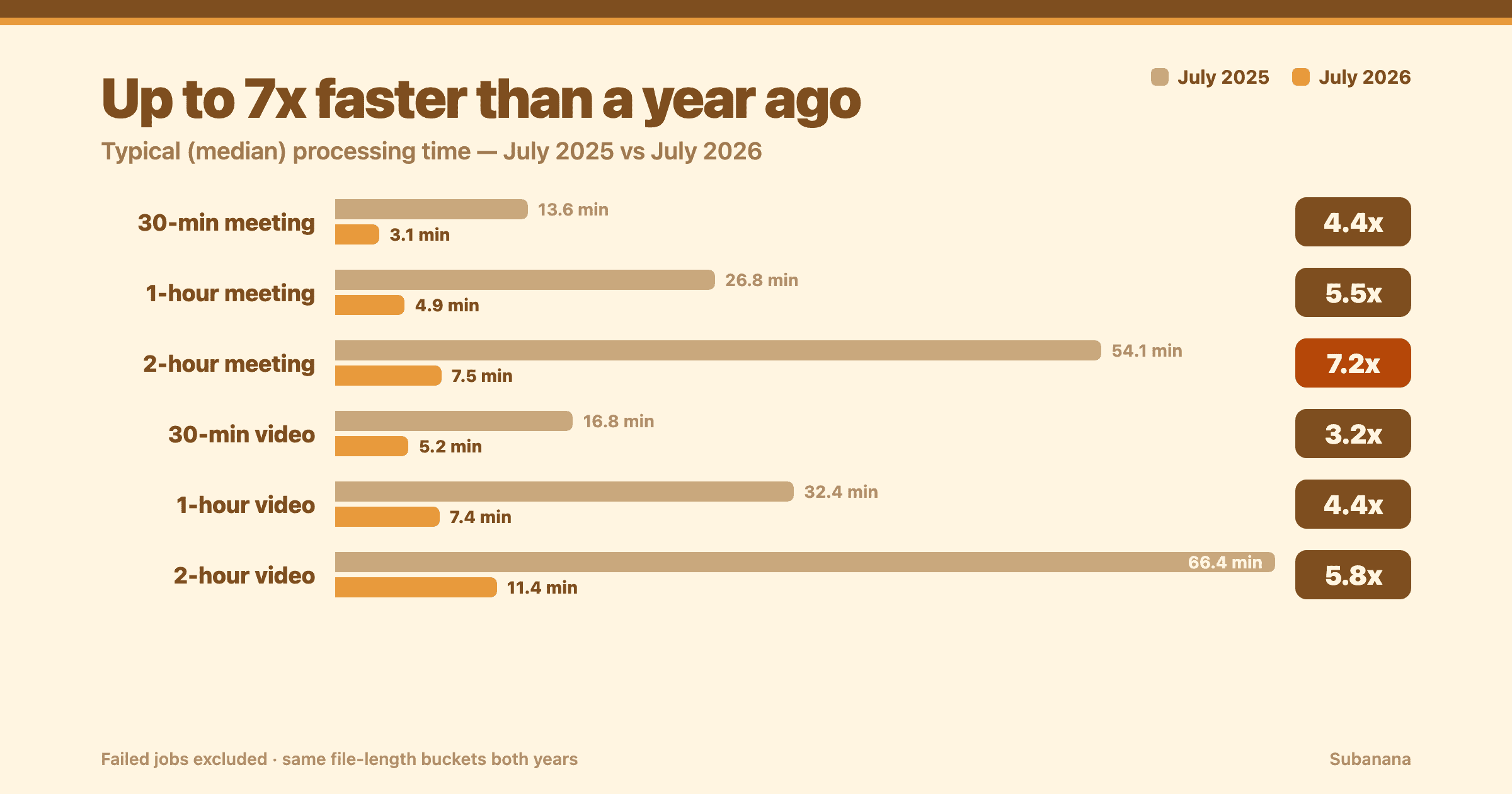
Median processing time, July 2025 against July 2026. The second number in each cell is the slow tenth — the one job in ten that takes longest. Medians flatter you; tails tell you what a bad day looks like.
| Job | July 2025 | July 2026 | Faster by |
|---|---|---|---|
| 30-min meeting | 13.6 min (p90 26.4) | 3.1 min (p90 5.9) | 4.4x |
| 1-hour meeting | 26.8 min (p90 61.9) | 4.9 min (p90 6.8) | 5.5x |
| 2-hour meeting | 54.1 min (p90 120.9) | 7.5 min (p90 13.4) | 7.2x |
| 30-min video | 16.8 min (p90 35.6) | 5.2 min (p90 12.1) | 3.2x |
| 1-hour video | 32.4 min (p90 136.4) | 7.4 min (p90 21.0) | 4.4x |
| 2-hour video | 66.4 min (p90 147.3) | 11.4 min (p90 28.9) | 5.8x |
The tail moved even more than the median, and it matters more. A year ago, one one-hour meeting in ten took over an hour to come back. Today the slow tenth starts at seven minutes — a bad job now is several times faster than a typical job was then. The worst-case hour-long video went from over two hours to 21 minutes. If you've been quietly padding your schedule around Subanana, you can stop.
Longer files gained the most — the two-hour meeting row is where the 7x lives. That's the opposite of what usually happens when a pipeline gets tuned against short demo clips, and it's the difference that changes behaviour: an hour-and-a-half wait is a "come back after lunch" job; seven minutes is a "stay in your chair" one.
And the trend hasn't flattened: the last week of July was the fastest week in Subanana's history, with one-hour videos at a 5.5-minute median.
The part that surprised me
Here's how the wait on a one-hour video splits up today. These stages overlap, so read them as rough proportions rather than a strict sequence.
| Stage | Share of the wait |
|---|---|
| Waiting in the queue | ~7% |
| Getting your file into the pipeline | ~2% |
| Preparing the media (audio, waveform) | ~25% |
| Transcribing | ~20% |
| Building and checking the cues | ~16% |
| Rendering the preview version you scrub through afterwards | ~29% |
Transcription — the AI part — is about a fifth of the wait.
The AI was never the bottleneck. Everyone assumes the speech-to-text is the slow part, because it's the part with the model in it. It isn't, and it hasn't been for a while. Roughly four-fifths of your wait is logistics: decoding your file, pulling a clean audio track out of it, generating the waveform, rendering the preview the editor needs so you can scrub through the result.
Which is exactly why the gains came where they did. Getting your file into the pipeline is down more than 90% just since June, and media preparation has roughly halved. There was never much to win on the transcription. There was a lot to win on everything else.
Three things follow from that table, and all are useful to know:
Meetings come back fastest. A meeting job skips the video-preview render entirely, which is a big part of why the meeting rows lead every video row of the same length.
Adding a translation won't hold up your results. Translation runs asynchronously — your original-language transcript and subtitles arrive just as fast, and the translated track follows on its own. If you've been skipping the translation target to protect your turnaround time, you don't need to. In subtitle mode you can add several targets to one job.
Your upload isn't in these numbers. The clock starts when processing begins, after your file lands. On a slow connection, the upload can be the longer half of your wait. If the video is already public, paste a YouTube or Instagram link and skip the upload — Subanana fetches it directly.
The part you can't shortcut
Anyone can rent a good speech-to-text model. That's the open secret of this category — the AI, the part with the mystique, is available to whoever signs up for an API key, which is why a new transcription app appears every week.
But the model is a fifth of your wait. The other four-fifths is the machinery around it: ingest, decoding, audio extraction, cue building, preview rendering, queuing. None of that can be rented. It has to be built, measured against real workloads, and rebuilt — and the only way it gets faster is engineering time spent on problems no demo ever surfaces.
That's what this year actually was. Not one release, and not a lucky model swap: the speedup has compounded almost every month for a year and a half. A weekend-built wrapper can match our transcription. The four-fifths is the part it can't match, and it's the part you feel every time you upload something long.
What this doesn't change
Retries are still free. When a transcription comes back looking wrong, the system re-runs the affected segments through a different model, underneath, without telling you. You aren't charged for the second pass — you pay for the file once, however many attempts it took. That was true a year ago and it's true now; it just happens faster.
The per-file limits have since been raised to 8 hours and 30 GB, and they are now the same on every plan, including free — though on the free plan, only the first 15 minutes of each file is transcribed.
Try it on something long
If you have been putting off a two-hour recording because you didn't want to lose an hour to it, that calculation has changed. It's about eleven minutes now.
AI meeting transcription and AI subtitling both run on the pipeline these numbers came from. If you want the longer read on what happens to a video between upload and export, transcribing video to text walks the whole path.
All figures are median processing times — July 2025 (complete month) against July 1–27, 2026 — grouped by source duration, failed jobs excluded, measured from the start of processing. The 2-hour rows cover files from 90 minutes to 3 hours. Your times will vary with file size, codec and load.