
A good board meeting minutes template records five things: who attended and whether there was a quorum, what the board decided, how each vote went, who declared a conflict of interest, and who owes what afterwards. The discussion itself mostly stays out.
Below are copy-ready templates for a corporate board and a nonprofit board, a motions and resolutions log, an action items register and a short AGM (annual general meeting) version. Each one explains why its lines exist, so you know what to keep when you adapt it to your own bylaws. For team meetings and one-on-ones, use our general meeting minutes template instead. This page covers boards only.
This is not legal advice; check with your company secretary or lawyer before you change how your board keeps its records.
What board meeting minutes must include
The shortest useful rule comes from the official Robert's Rules FAQ: "Minutes are a record of what was done at a meeting, not a record of what was said." Everything in a board template follows from that. You record actions, the facts that make those actions valid, and enough context to find the supporting papers later.
| Item | What to write | Why it matters |
|---|---|---|
| Meeting basics | Organization name, regular or special meeting, date, start time, place or video link, who presided, who took the minutes | Identifies exactly which meeting the minutes record |
| Notice | How and when notice went out, or that directors signed a waiver | Shows the meeting was properly called under your bylaws |
| Attendance | Directors present, directors absent, guests with their role, anyone who left or returned and at what time | Shows who could vote on each item |
| Quorum | "A quorum was present," with the count | Failing to document a quorum is the first mistake on the Nonprofit Law Blog's list |
| Conflicts of interest | Who declared, on which item, and whether they left the room and did not vote | Shows interested directors stayed out of the decision |
| Motions | Exact wording, mover, seconder, result and the vote count, including votes against and abstentions | This is the board's action; it has to be unambiguous |
| Resolutions | Formal "RESOLVED, that..." text for significant actions | Gives anyone relying on the decision the exact text that was approved |
| Reports received | One line per report, with the report attached or referenced | Proves the board was informed without copying the report |
| Executive session | Time in, time out and the general topic | Keeps confidential detail out of the general minutes |
| Action items | What, who and by when | The follow-up list for the next meeting |
| Close | Adjournment time, secretary's signature line and the date the minutes were approved | Turns a draft into the official record |
Accounting firm KT LLP puts it plainly: "No specific requirements dictate what minutes should look like". The format is yours to choose. The contents above are what the sources below consistently recommend.
Template 1: Corporate board of directors minutes
Use this for a regular meeting of a company board. Replace everything in square brackets.
[COMPANY NAME]
MINUTES OF A [REGULAR / SPECIAL] MEETING OF THE BOARD OF DIRECTORS

Date: [date]            Time: [start time]
Place: [address or video link]
Notice: [Given on (date) by (method) / Waived in writing by all directors]

Directors present: [names]
Directors absent: [names]
Also present: [name, title] (for items [x] only)
Chair: [name]           Secretary: [name]

1. CALL TO ORDER AND QUORUM
The Chair called the meeting to order at [time]. The Secretary confirmed
that [n] of [n] directors were present and that a quorum was present.

2. DECLARATIONS OF INTEREST
[None declared.] / [Director (name) declared an interest in item (x),
left the meeting for that item and did not vote.]

3. MINUTES OF THE PREVIOUS MEETING
The minutes of the meeting held on [date] were approved [as circulated /
as corrected].

4. REPORTS
4a [CEO report]: received. Copy filed with these minutes.
4b [Financial report for (period)]: received. Copy filed with these minutes.

5. MATTERS FOR DECISION
5a [Item title]
Motion: [exact wording]
Moved: [name]    Seconded: [name]
Vote: For [n], Against [n], Abstained [n]. Motion [carried / failed].

RESOLVED, that [text of the resolution].

6. ACTION ITEMS
[Action], [owner], due [date]
[Action], [owner], due [date]

7. EXECUTIVE SESSION
[See executive session wording below, or "None."]

8. ADJOURNMENT
There being no further business, the meeting adjourned at [time].
Next meeting: [date].

______________________          ______________________
Secretary                       Chair (if your bylaws require it)
Approved on: [date of approving meeting]
Template 2: Nonprofit board meeting minutes
Nonprofit minutes follow the same skeleton with three differences. If your nonprofit has a conflict-of-interest policy, the declaration item is where it shows up in the record. Staff reports (executive director, treasurer, committees) take up more of the agenda. And for US tax-exempt organizations, the timing of approval shows up on Form 990, covered in the approval section below.
[ORGANIZATION NAME]
BOARD OF DIRECTORS MEETING MINUTES
[Regular / Special] meeting, [date], [time], [place or video link]
Notice: [how and when given]

Present: [directors]
Absent: [directors]
Staff and guests: [name, role]
Presiding: [Board Chair]      Minutes taken by: [Secretary or delegate]

1. Call to order and quorum
Called to order at [time]. Quorum confirmed: [n] of [n] directors present.

2. Conflict of interest check
The Chair asked whether any director had a conflict with any agenda item.
[No conflicts declared.] / [(Name) declared a conflict with item (x) and
was recused from discussion and voting on that item.]

3. Consent agenda
Motion to approve the consent agenda, including the minutes of [date].
Moved: [name]. Seconded: [name]. Carried [For n, Against n, Abstained n].

4. Executive director's report
Received. Key items requiring board action: [list or "none"].

5. Treasurer's report
Financial statements for [period] received and filed.
[Motion to accept, if your bylaws call for one, with mover, seconder, vote.]

6. Committee reports
[Committee]: [one-line summary]. [Any motion, with mover, seconder, vote.]

7. New business
7a [Item]
Motion: [exact wording]
Moved: [name]. Seconded: [name].
Vote: For [n], Against [n], Abstained [n], Recused [name]. [Carried / Failed].

8. Action items
[Action], [owner], [due date]

9. Executive session
[Wording below, or "None."]

10. Adjournment
Adjourned at [time]. Next meeting: [date].

Minutes submitted by: ____________________ (Secretary)
Approved by the board on: [date]
A consent agenda bundles routine items (last meeting's minutes, standard reports) into a single vote. If a director asks for an item to come off it and be discussed separately, record that too.
Template 3: Motions and resolutions log
Keep this table at the end of the minutes, or as a running register across the year. It gives an auditor or a new director every decision on one page.
| No. | Agenda item | Motion or resolution (exact text) | Moved | Seconded | For | Against | Abstained | Recused | Result |
|---|---|---|---|---|---|---|---|---|---|
| M1 | 5a | RESOLVED, that the operating budget for the next fiscal year be approved as presented. | [name] | [name] | 6 | 1 | 0 | 0 | Carried |
| M2 | 5b | That the board authorize the CEO to sign the lease for [premises]. | [name] | [name] | 5 | 0 | 1 | 1 ([name]) | Carried |
Record abstentions separately from votes against. Robert's Rules describes an abstention as "a refusal to vote", so it is not counted as a vote against. Recusals (a director stepping out because of a conflict) are different again, and the Nonprofit Law Blog advises recording both.
Template 4: Action items register
| # | Action | Owner | Due | From item | Status at next meeting |
|---|---|---|---|---|---|
| 1 | Circulate the signed lease to all directors | [name] | [date] | 5b | |
| 2 | Bring three audit-firm quotes to the next meeting | [name] | [date] | 5c |
Review this list as a standing item at the start of every meeting, so decisions do not quietly stall between meetings.
Executive session and confidential items
Boards go into executive session (directors only, staff excused) for matters such as a CEO review or pending litigation. The general minutes should show that the session happened and its broad topic, and nothing more. The Nonprofit Law Blog, quoting Blue Avocado, says the specifics "may be confidential and appear only in a set of confidential-to-the-board minutes or other notes."
EXECUTIVE SESSION
At [time] the board went into executive session to discuss [general
topic, e.g. "a personnel matter"]. Staff were excused.
The board came out of executive session at [time].
[If a vote was taken:] The board voted to [action, at the level of detail
the board has agreed to disclose]. Vote: For [n], Against [n], Abstained [n].
Votes can be taken in executive session; Robert's Rules confirms it and notes that "Proceedings in an executive session are secret". If the board acts there, record the vote in the confidential record your policy sets out; the general-minutes block above shows the level of detail you can disclose.
Short version: AGM minutes template
An annual general meeting is a members' or shareholders' meeting, not a board meeting, but the secretary often takes both. The skeleton is shorter:
[ORGANIZATION] ANNUAL GENERAL MEETING, [date], [time], [place]
Members present: [n] in person, [n] by proxy. Quorum: [confirmed]
Chair: [name]         Secretary: [name]

1. Minutes of the previous AGM: approved [as circulated / as corrected]
2. Annual report: presented by [name]
3. Financial statements for [year]: presented and [received / approved]
4. Election of directors: [names elected], [vote count if contested]
5. Appointment of auditor: [if applicable]
6. Other resolutions: [text, mover, seconder, result]
7. Close: [time]
A filled-in example
This excerpt is a made-up example so you can see the level of detail. Notice what is missing: nobody's arguments, only the decisions and the facts that make them valid.
MAPLE STREET ARTS COUNCIL
MINUTES OF THE REGULAR BOARD MEETING, 14 SEPTEMBER 2026
6:30 p.m., Community Room and by video link

Present: J. Alvarez (Chair), P. Chen, R. Okafor, S. Patel, D. Moore,
T. Nguyen, L. Haddad
Absent: M. Rossi
Staff: K. Brennan, Executive Director

1. Call to order and quorum
Called to order at 6:32 p.m. Quorum confirmed: 7 of 8 directors present.

2. Conflict of interest check
S. Patel declared a conflict with item 7a (her firm submitted a quote)
and was recused from discussion and voting on that item.

7a Selection of auditor
S. Patel left the meeting at 7:10 p.m.
Motion: That the Council engage Harbor & Lane CPAs as auditor for the
2026 fiscal year at the fee quoted.
Moved: R. Okafor. Seconded: T. Nguyen.
Vote: For 5, Against 1, Abstained 0, Recused 1 (S. Patel). Carried.
S. Patel returned at 7:24 p.m.

Action: K. Brennan to sign the engagement letter by 30 September.
How to write board meeting minutes: from recording to approved record
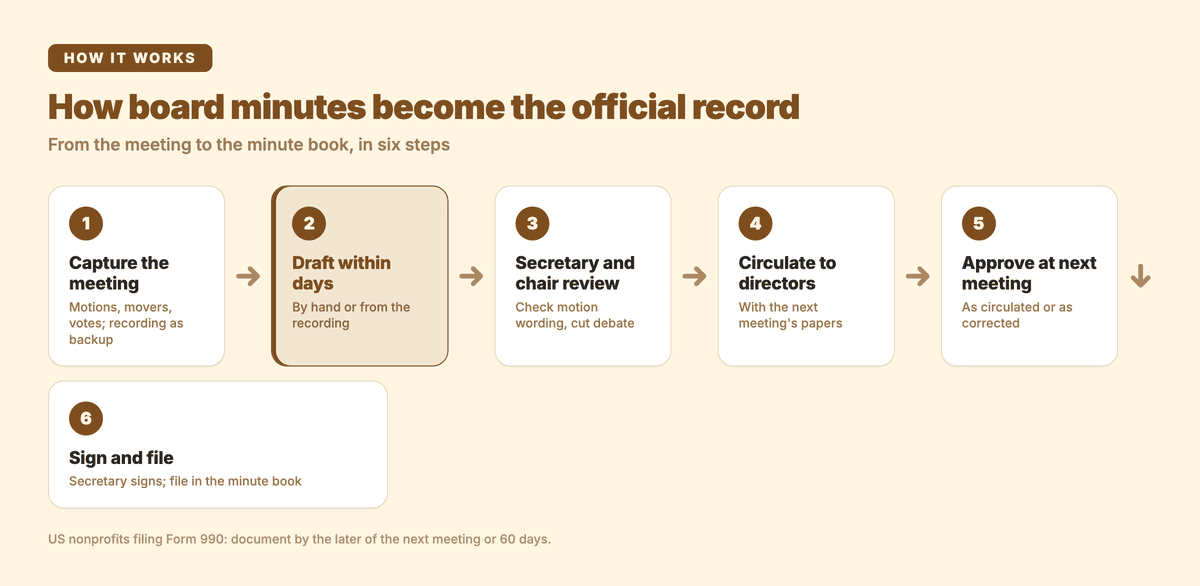
- Capture during the meeting. The secretary notes motions, movers, seconders and vote counts as they happen. A recording is a backup for checking wording afterwards, not a substitute for knowing the count.
- Draft within a few days. Details fade fast. Write the draft while the secretary and chair still remember what the board meant.
- Secretary and chair review. The chair checks that each motion says what the board voted on. Opinions and debate come out.
- Circulate to directors with the next meeting's papers.
- Approve at the next meeting. Directors propose corrections, and the minutes are approved as circulated or "as corrected". Robert's Rules says the new minutes should record only that they were approved as corrected, without listing each change.
- Sign and file. Once approved, the minutes are signed, generally by the secretary (according to Social Enterprise for Nonprofits), plus the chair if your bylaws say so. File the signed copy in the minute book with the notice and any documents the actions refer to.
Timing for US nonprofits. Form 990, Part VI, Section A, Question 8 asks whether the organization contemporaneously documents its board and committee meetings. The Form 990 instructions define contemporaneous as "by the later of (1) the next meeting of the governing body or committee (such as approving the minutes of the prior meeting), or (2) 60 days after the date of the meeting or written action." In practice: approve at the next meeting, and do not let a draft sit for months.
Common mistakes in board minutes
- Writing a transcript. The Nonprofit Law Blog lists "Drafting a transcript of everything said at the meeting" as a common mistake, partly because anything written down can be read later by people with access to the minutes. It also says organizations "are not required to, nor should they, record every detail or statement said at the meeting."
- Recording opinions. "Director Chen was strongly opposed" belongs nowhere in the minutes. "Vote: For 5, Against 1" is enough.
- No quorum line. Write it every time, with the count.
- Vague actions. "The board discussed the budget" records nothing. Write the motion, the mover, the seconder and the result.
- Dropping the dissent. Record votes against, abstentions and recusals. They show how each director voted.
- Confidential detail in the general minutes. Executive session specifics go in the confidential record.
- Approving late. A draft that waits three meetings for approval is harder to correct and, for US nonprofits, can fall outside the Form 990 definition above.
Let Subanana draft the minutes from your recording
The slow part of minute-taking is turning an hour of discussion into the few lines above. That step can start from a recording, so the secretary edits a draft instead of starting from a blank page.
1. Record the meeting.
- Google Meet or Microsoft Teams: connect Google Calendar or Outlook Calendar and Subanana's meeting Notetaker joins the call and records it. The project, with transcript and summary, is created after the meeting ends. Remove the Notetaker from the call before the board goes into executive session, because the recording and transcript would otherwise hold it.
- In the boardroom: open Record in the browser and choose Audio only. It works on every plan; on the free plan the transcript and summary cover only the first 15 minutes of each recording, so a full-length board meeting needs a paid plan. Stop the recording for executive session.
- Zoom: the Subanana Meeting Recorder Chrome extension records Zoom calls running in a browser tab. You can also upload the Zoom recording afterwards.
- Already have a file? Upload it. Files up to 8 hours and 30 GB are accepted.
2. Teach it your board's names. Add directors' names, the organization's name and any acronyms to a Glossary so they are spelled correctly. Upload the agenda and board pack (PDF, DOCX, PPTX and other formats) as a Background Pack so the draft knows what each agenda item refers to.
3. Build your minutes format as a template. The Template Library has 14 built-in summary templates, including Meeting, Business and Legal. For board minutes, build your own with "Generate with AI": describe the format above (quorum line, declarations, motions with mover, seconder and vote, resolutions, action items) and save it. Then pick it as the summary template for each board meeting project.
4. Check the draft against the recording. The transcript identifies speakers, and every meeting summary lists decisions and action items. That is how the secretary confirms who seconded a motion or what the exact wording was. You can also ask the transcript directly, for example "What was the vote count on the auditor motion?" If you just want to see how a transcript of your last board call reads, run it through the free AI meeting transcription tool first.
5. Share and export. Share the project with the chair so they can check the draft against the transcript, then review the summary yourself. Sharing the project shares the transcript too, so do not share a project whose recording includes the executive session. Download the summary as a Word file and paste it into your minute book format.
A draft is a draft. The secretary still decides what goes in, the executive session still stays out, and the board still approves the minutes at the next meeting. If you have tried pasting a transcript into a chatbot instead, this guide on ChatGPT and meeting minutes covers where that approach works and where it falls short.
FAQ
How detailed should board meeting minutes be? Detailed enough that someone who was not there can tell what was decided, how, and by whom. Record motions, votes, quorum, conflicts and action items; leave out the debate.
Who signs board meeting minutes? Generally the secretary, once the board has approved them. Some bylaws also require the chair's signature, so check yours.
When are board minutes approved? At the next board meeting, as circulated or as corrected. US tax-exempt organizations filing Form 990 should aim to document within the later of the next meeting or 60 days.
Should we record board meetings? Some boards do, as a backup for the secretary. Agree a policy first: tell everyone the meeting is being recorded, and decide whether the recording is kept or deleted once the minutes are approved. Your bylaws and local law may affect this, which is another question for your company secretary or lawyer.
Can AI write board meeting minutes? It can write the first draft from a recording. It cannot decide what is confidential, confirm a vote the recording did not capture clearly, or approve anything. The secretary reviews the draft and the board approves it, the same as minutes written by hand.
What is the difference between a motion and a resolution? A motion is the proposal put to the vote. A resolution is the formal written statement of what the board decided, usually starting "RESOLVED, that...". Boards often write significant actions, such as approving a budget, opening a bank account or signing a lease, as resolutions.
Record your next board meeting, build your minutes template once, and let Subanana draft the minutes for your secretary to review.