
Look up "types of interviews" and you'll get a different number every time. Indeed says 7. Texas A&M's career center says 5. Nelson Connects says 6. Harvard Business Review says 4, but a different 4 than you'd guess.
None of them is wrong. They're counting different things. Once you separate the axes, the taxonomy holds together, and it maps cleanly onto a decision that matters more than the label: what you need your recording and transcript to do once the interview starts.
Why nobody agrees on a number
I went through the sources Google's own results surface for this query: Indeed, Nelson Connects, SocialTalent, VidCruiter, Texas A&M, University of Iowa's career center, and HBR's interviewing-style podcast with Anna Papalia. VidCruiter's own page is the clearest tell. It groups interview types under four separate headings on the same page (who takes part, what the interview assesses, interview format, and how structured it is), because those are genuinely different classification systems, not competing counts of the same thing. The University of Iowa career center's list runs to 17 named types once you fold in stage (screening, follow-up, selection) alongside format and focus.
Four axes keep recurring across these sources:
- Structure: how much of the interview is scripted in advance.
- Format: how many people are in the room, and in what arrangement.
- Focus: what the interviewer is actually testing for.
- Personal style: how the interviewer (or candidate) naturally behaves.
Each answers a different "how many types" question. Here's each one, sourced.
By structure: structured, semi-structured, unstructured
This is the research-methodology axis. Per VidCruiter, a structured interview is "a systematic, consistent interview process" run from a closely-followed guide of pre-vetted questions, with the highest reliability and the easiest cross-candidate comparison. A semi-structured interview keeps a loose guide but leaves room to reorder or add questions as the conversation develops. An unstructured interview has no fixed guide at all ("format and content can change between candidates"), trading consistency for depth and carrying the highest bias risk.
By format: who's actually in the interview
This is the axis Indeed's "7 types" answer is built on: individual (one interviewer, one candidate), panel (several interviewers, one candidate), group (multiple candidates at once), multiple-round (several sequential one-on-ones), and phone or video screens as an early filter. Texas A&M's shorter "5 types" list covers the same ground with fewer subdivisions: traditional one-to-one, sequential (multiple interviewers, one after another), and group/panel combined into one category.
By focus: what's being tested
This is the technique axis. Nelson Connects' "6 styles" names behavioral, case, panel, situational, technical and traditional. SocialTalent adds competency-based and assessment days to a similar list. Behavioral interviews probe past conduct to predict future performance. Case and situational interviews present a scenario and watch the reasoning. Technical interviews test role-specific skill directly. Stress interviews (per University of Iowa) deliberately apply pressure to see how a candidate holds up.
By personal style: how the person behaves
This one is worth flagging on its own, because it's easy to mix up with the structure axis above, and it's the actual source behind the "four styles of interviewing" answer you'll see cited. Anna Papalia's framework, discussed on HBR's Ideacast, sorts interviewers (and candidates) into four behavioral types: Charmer, Challenger, Examiner and Harmonizer, not structured, semi-structured or unstructured. It's a genuinely different axis: personality and approach, not format or preparation level.
None of these four axes is "the" taxonomy. They're four honest, sourced answers to four different questions, which is exactly why the PAA results disagree.
What actually changes once you hit record
None of those career-advice pages gets into this part: once you're the one capturing an interview, for hiring, research, journalism, or a podcast, the label matters less than two practical facts about it. How many speakers are you recording, and how literally do you need their words captured?
Speaker count: the format axis, translated
A one-on-one interview is the easy case. Two speakers, and any transcript tool with speaker identification (diarization) will separate them cleanly. A panel interview is harder: three or more interviewers plus one candidate, and if the diarization mislabels who asked which question, the transcript misattributes it. A group interview (multiple candidates, one or more interviewers) is harder still, and it's exactly the case where getting the speaker count right, rather than letting a tool guess wrong, matters most.
Subanana's transcript mode gives you a manual-or-auto number-of-speakers setting alongside automatic diarization, precisely because "auto" isn't always the right call on a five-person panel. Telling it there are five speakers up front is more reliable than letting it infer that from the audio alone. Speaker names are auto-applied only when the workspace already knows the person; anything uncertain gets suggested for you to confirm rather than guessed silently. If you're setting up the recording side of this for the first time, the step-by-step transcript workflow covers speaker labelling in more depth than I'll repeat here.
For panel or group interviews conducted over video, capture matters as much as transcription. A Google Meet or Microsoft Teams bot handles both automatically. Zoom isn't covered by a bot, but the Subanana Chrome extension can capture a Zoom tab directly.
How literal: the structure and focus axes, translated
A structured or technical interview tends to produce a clean, transactional Q&A, so a default tidied transcript (fillers and false starts removed) reads fine and is usually what you want for review or a hiring file. An unstructured or behavioral interview, where a candidate might tell a five-minute story in response to "tell me about a time when...", is a different case. The exact phrasing sometimes carries meaning a cleaned-up paraphrase loses, and a stress interview specifically depends on capturing tone and wording under pressure, not a smoothed-over version of it.
Subanana ships an optional Word-for-word toggle on single-file transcript and meeting uploads that keeps filler words instead of tidying them: the setting to reach for when the exact phrasing is the thing you're reviewing, not just the content. The default stays cleaned, which is the right call for a straightforward structured interview. If you want to see what a cleaned versus verbatim transcript actually looks like side by side before you decide which you need, these examples lay out the formatting conventions.
Technical and case interviews carry another wrinkle: role-specific jargon, tool names, or acronyms that a general transcription model won't spell consistently. A glossary you set up in advance, pinning the terms and names that will come up, keeps those consistent across the transcript instead of drifting between spellings.
One more small thing that matters more than it should: transcript mode automatically restores punctuation and paragraph breaks. This is forced on for transcript and meeting output; it's not applied to subtitles, which conventionally skip punctuation. For a 45-minute unstructured interview, the difference between a wall of unbroken text and something with actual paragraph breaks is the difference between a transcript you can skim for the quote you need and one you can't. If accuracy across the full session, not just the transcript formatting, is what you're optimizing for, this accuracy-focused guide is the deeper resource; I won't re-cover that ground here.
The taxonomy, mapped
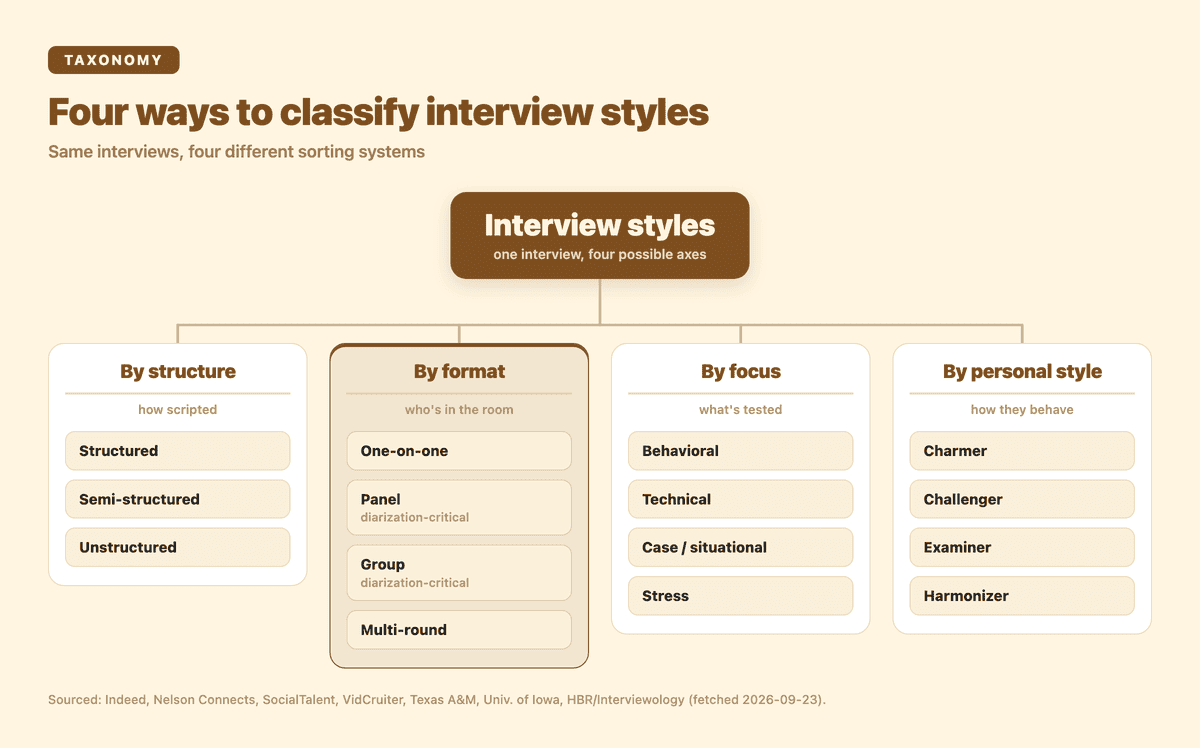
Read top to bottom: structure (structured, semi-structured, unstructured) governs how scripted the questions are; format (individual, panel, group, multiple-round, phone/video screen) governs who's in the room, and panel and group are the two entries where getting the speaker count right matters most; focus (behavioral, technical, case, situational, competency-based, stress) governs what's being tested; personal style (Charmer, Challenger, Examiner, Harmonizer) governs how the interviewer behaves. Every entry traces back to one of the seven sources cited above.
FAQ
What are the 7 types of interviews? Per Indeed's breakdown: individual, group, panel, technical, multiple-round, phone screen, and informational. These are grouped by who's involved and how the process is staged. Technical is the one entry here that also signals focus, which is its own axis covered below.
What are the four styles of interviewing? The commonly-cited "four styles" (Charmer, Challenger, Examiner, Harmonizer) come from Anna Papalia's Interviewology framework, discussed on HBR's Ideacast. It's a personal-style axis (how someone naturally behaves in an interview), not the structured/semi-structured/unstructured research axis. The two get conflated often, but they're answering different questions.
What are the five types of interviews? Texas A&M's career center lists five: traditional (one-to-one), behavioral, sequential (multiple interviewers in turn), group/panel, and technical, a shorter version of the same format axis Indeed expands to 7.
What are the 5 top interview techniques? The focus/technique axis: behavioral (past conduct predicts future performance), situational (hypothetical scenarios), competency-based (scored against specific skills), technical (role-specific problem-solving), and case (business-scenario reasoning), drawn from Nelson Connects and SocialTalent.
Where to go from here
Whatever style of interview you're running or sitting in, the practical questions are the same two: how many speakers, and how literal does the record need to be. Get those two settings right in your meeting transcription tool before you hit record, and the taxonomy above stops being trivia and starts being a checklist.