
Fathom's pitch is hard to argue with at the entry tier: free, unlimited meeting recordings, unlimited AI transcripts, and instant AI summaries. There are no minute caps and no time limits. The paid tiers add advanced AI summaries, action items and a meeting assistant, then CRM field sync and deal coaching on Business and SSO / SCIM on Enterprise. Its home page also advertises SOC 2 Type II, GDPR and HIPAA compliance.
If you're searching for a Fathom alternative, you're usually hitting one of three gaps: language coverage (Fathom's help center lists 38 transcript languages, with no Chinese or Cantonese entry), live multilingual event captioning, or you want something more focused than a sales-team CRM-integrated meeting assistant.
Subanana plays in that narrower transcription + live-caption space, with a specific strength in harder real-world audio: recordings that mix several languages, and Asian languages such as Mandarin, Japanese, Korean and Cantonese. Here is how the two compare.
This post compares each tool using its own published pages (pricing and features), re-checked on 31 October 2026. We did not run a head-to-head accuracy test; both tools have free tiers, and your own audio is the right way to test accuracy.
Roundup context: Best AI Meeting Transcription Tools 2026 → — this post is the Fathom deep dive.
TL;DR
- Pick Fathom if your team is English-only, you live inside Salesforce or HubSpot and want native CRM sync, you need a generous free tier with unlimited recordings + transcriptions + AI summaries, or HIPAA / SOC 2 Type II compliance is required.
- Pick Subanana if a meaningful portion of your work is multilingual or Asian-language audio, you run live multilingual events with audience-facing captions, you want to choose the model in an AI agent chat over your recordings, or you're a team of 3+ on light-to-moderate per-user usage where workspace pricing scales better than per-seat.
- The shape of the choice: Fathom is the sales-team meeting assistant with a generous free tier and CRM-native workflow. Subanana is the multilingual transcription + live-event-captioning specialist. They overlap on "transcribe English meetings" but their best uses point at very different jobs.

Pricing snapshot (October 2026)
Fathom (per seat, USD)
| Plan | Monthly | Annual (effective /mo) | Recordings + AI summaries | CRM field sync | Min seats |
|---|---|---|---|---|---|
| Free | $0 | — | Unlimited recordings + transcriptions + instant AI summaries | — | 1 |
| Premium | $20 | $16 | Free features + advanced summaries + AI action items + conversational meeting assistant + custom meeting bot | — | 1 |
| Team | $19/seat | $15/seat | Premium + global search across calls + playlists + team collaboration | — | 2 |
| Business | $34/seat | $25/seat | Team + CRM field sync + Deal View + coaching metrics & AI scorecards + advanced summaries | ✅ | 2 |
| Enterprise | Contact sales | Contact sales | Business + SSO / SCIM provisioning + custom data retention programs | ✅ | — |
The Team and Business tiers require a 2-user minimum. All tiers retain "unlimited recordings + transcriptions." The differences between tiers are AI feature depth and CRM workflow rather than transcription quotas.
Subanana (per workspace, USD)
| Plan | Monthly | Annual (effective /mo) | File limit | Minute allocation |
|---|---|---|---|---|
| Free | $0 | — | 8 hr/file, 30 GB (first 15 min of each file transcribed) | — |
| Lite | $18 | $9 | 8 hr/file, 30 GB | 60 min/mo (720 min/yr) |
| Pro | $30 | $18 | 8 hr/file, 30 GB | 180 min/mo (2,160 min/yr) |
| Max | $75 | $50 | 8 hr/file, 30 GB | 600 min/mo (7,200 min/yr) |
| Enterprise | Contact sales | Contact sales | Custom | Custom |
Per-workspace pricing. Free tier doesn't allow subtitle/transcript download; paid tiers enable downloads. Subanana minutes don't roll over across billing cycles (unused minutes do carry over when you switch from one paid plan to another).
The two pricing models are very different shapes. Fathom's free tier is unusually generous for individual meeting capture, no minute cap, unlimited recordings + AI summaries. Subanana's free tier is more constrained, it transcribes only the first 15 minutes of each file, though the 30 GB / 8 hour per-file limit is the same on every plan, and is sized for testing rather than ongoing use. For paid usage the shapes differ. Subanana charges per workspace, with a minute allotment that everyone in the workspace shares; Fathom charges per seat and lists recording and transcription as unlimited. A team of 3+ with light-to-moderate usage can pay less on Subanana, while a team that records many hours of meetings every week will outrun the minute allotment, and there Fathom's unlimited model is the better fit.
Where Fathom wins
We start here because these are real strengths sourced from Fathom's published pages.
1. Genuinely generous free tier
Fathom Free includes unlimited recordings, unlimited transcriptions, and instant AI summaries, at $0 with no minute cap. This is one of the most generous free tiers in the meeting transcription category. Subanana's free tier transcribes only the first 15 minutes of each file (the 30 GB / 8 hour per-file limit is the same on every plan), which is sufficient for testing the product but not for ongoing use. For solo professionals who only need basic AI meeting capture and don't need multilingual / live-captioning workflows, Fathom's free tier may be the right tool, full stop, no upgrade pressure.
2. Native CRM and workspace integrations (Salesforce, HubSpot, Notion, Asana)
Fathom's Business tier includes native CRM field sync, and its home page lists syncs with Slack, Salesforce, HubSpot, Notion and Asana. Subanana doesn't currently ship native CRM, dialer, or push-out integrations. For sales teams whose workflow lives in Salesforce or HubSpot, Fathom's tighter integration loop is a real advantage.
3. Sales coaching workflow (Deal View, AI Scorecards)
Fathom Business adds Deal View, coaching metrics, and AI scorecards, sales-coaching tools where managers can review rep performance, track deal health, and standardise feedback. Subanana doesn't compete in this category. For sales-led organisations, Fathom is purpose-built for the workflow.
4. SOC 2 Type II + HIPAA compliance
Fathom's home page advertises SOC 2 Type II, GDPR and HIPAA compliance, and its pricing page lists a signed BAA (the agreement HIPAA-covered organizations require) on Enterprise only. Subanana doesn't currently advertise HIPAA or SOC 2 compliance. For healthcare workflows or enterprise procurement that requires either, Fathom is the correct pick today.
5. ChatGPT & Claude integrations for downstream processing
Fathom's pricing page lists "Claude & ChatGPT Integrations" to surface meeting context in an external assistant. For teams that have heavy workflows in those tools, Fathom's downstream-processing affordances are documented.
6. Bot-free capture as a UX advantage
Fathom advertises bot-free capture (listed as a beta feature for Mac on its pricing page), alongside its regular bot capture. For teams that don't want attendees to see a recording bot in the meeting, this is a documented UX advantage. Subanana's Google Meet / Microsoft Teams capture uses a meeting bot, which does appear in the participant list; its Chrome extension and in-browser recording studio need no bot, but they are separate capture paths.
Where Subanana wins
1. Multilingual and Asian-language transcription
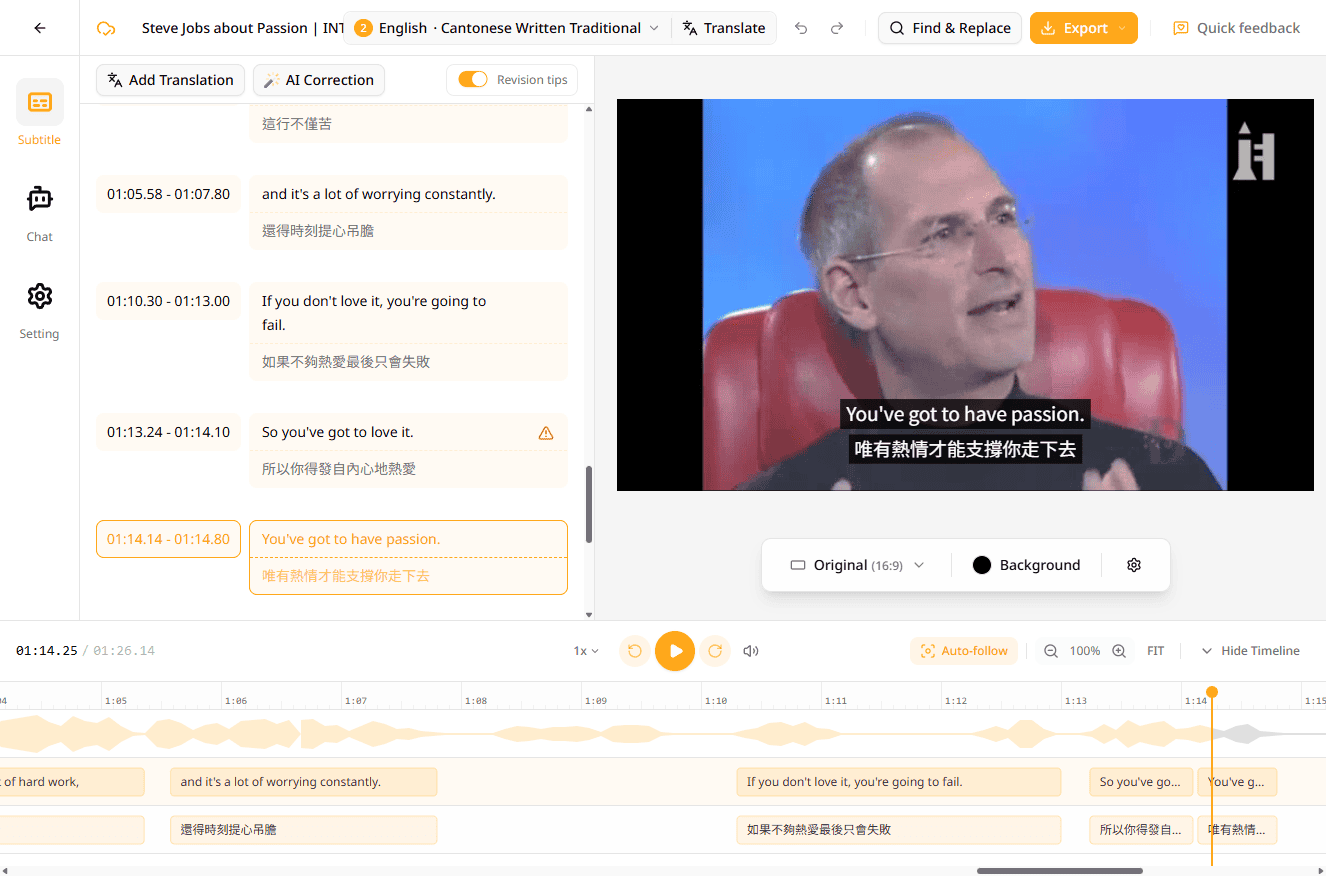
Fathom's help center lists 38 transcript languages, including Japanese and Korean, but no Chinese or Cantonese entry (list dated May 2025). Subanana covers 95+ languages. It doesn't publish per-language accuracy numbers; it benchmarks speech-to-text models and routes each file to the best one for the source language and use case. Paid plans add a Multiple-languages mode for recordings that mix up to 10 languages in one file, and Subanana supports the spoken-to-written conversion that some professional contexts require.
2. Spoken-to-written conversion for languages that need it
For languages with a wide gap between how people speak and how text is written, Subanana converts colloquial speech into clean written form automatically. Cantonese is the clearest example (e.g. spoken "我哋 call 完之後 follow up" becomes written Chinese). We found no description of this conversion step in Fathom's published pages.
3. Live multilingual translation with audience-facing captions
Subanana runs real-time captioning + translation for live events with an audience-facing shareable link — attendees scan a QR code and each picks one display language for the live captions on their phone — the original, or any of the up to 5 translation targets the host pre-configured for the event. For conferences, university lectures, multilingual board meetings, Subanana is purpose-built.
4. Model picker in the AI agent chat
Subanana's AI agent chat, inside both the meeting editor and the subtitle editor, lets you pick which model answers your questions about a recording, on every plan including free, from a list that grows as new models ship. The meeting summary itself always uses the backend-recommended model, with no picker. Fathom's Claude and ChatGPT integrations are described as surfacing meeting context in your LLM of choice outside the product, which is a different thing from choosing the model inside the app.
5. Bilingual SRT export
Subanana exports a single SRT file containing both source transcription and translated text (one above the other per cue). Useful for bilingual content, one language subtitled over another.
6. Per-workspace pricing for teams (above 2 seats)
Subanana's per-workspace pricing means a 5-person team pays the same as a 1-person team at a given tier. Fathom Team is $15/seat/mo on annual billing (minimum 2 seats) and Business is $25/seat, so a team's bill grows with every seat added. Subanana Pro is about $18/mo on annual billing for the whole workspace, but it includes a fixed pool of 2,160 minutes a year shared by everyone in it. For teams of 3+ on light-to-moderate usage, the math favors Subanana; for heavy meeting volume or CRM-integrated sales workflows, the comparison flips because Fathom's unlimited recording and CRM features are the value.
7. User glossary for pinning brand, product, and jargon terms
Subanana lets you supply a glossary so the transcription pins brand names, product names, people, and industry jargon, workspace-level and per-project lists, bulk-imported from XLSX / CSV, applied universally or per language. Fathom documents a Transcription Dictionary of up to 50 terms, added manually, with no bulk import. Subanana sets glossary size limits by plan, shown on its pricing page. If you need granular, structured term control, different glossaries per project, per source language, check that Fathom documents the same level of control before you rely on it.
Side-by-side feature table
| Feature | Fathom Business | Subanana Pro |
|---|---|---|
| Free tier | ✅ Unlimited recordings + transcriptions + AI summary | ✅ 30 GB / 8 hr per file; first 15 min of each file transcribed |
| Multilingual / Asian-language coverage | 38 languages listed in help center, including Japanese and Korean; no Chinese or Cantonese entry | ✅ Benchmarks STT models, routes to best per source language (no per-language accuracy figures published) |
| Spoken-to-written conversion (e.g. Cantonese) | Not compared here | ✅ |
| Model picker in AI chat | Not compared here | ✅ (AI agent chat; summary uses the recommended model) |
| Live multilingual captions (event-scale, audience-facing) | Not compared here | ✅ |
| Bilingual SRT (single file, dual-track) | Not compared here | ✅ |
| User glossary / term pinning | Transcription Dictionary: up to 50 terms, added manually | ✅ Workspace + per-project, bulk import (XLSX/CSV), per-language |
| Native Salesforce / HubSpot CRM sync | ✅ | ❌ (manual export) |
| Deal View / AI Scorecards (sales coaching) | ✅ | ❌ |
| SOC 2 Type II + HIPAA compliance | SOC 2 Type II advertised; signed BAA on Enterprise only | ❌ |
| Bot-free meeting capture | ✅ (beta, Mac) | Partly (bot for Meet / Teams; Chrome extension and browser recording need none) |
| Pricing model | Per seat (min 2 on team plans) | Per workspace |
| Storage model | Recordings and call storage listed as unlimited | No aggregate cap; per-file limit only (30 GB on every plan, including free; free transcribes the first 15 min of each file) |
So which should you pick?
Pick Fathom if:
- Your team is English-only or English-heavy
- You live inside Salesforce or HubSpot and need native CRM sync
- You're a solo professional who wants a generous free tier with unlimited AI meeting capture
- Sales coaching workflows (Deal View, AI Scorecards) are part of your job
- HIPAA or SOC 2 Type II compliance is required
- You prefer bot-free meeting capture
Pick Subanana if:
- A meaningful portion of your work is multilingual or Asian-language audio (Mandarin, Japanese, Korean, Cantonese among them)
- You want to choose the model in an AI agent chat over your recordings
- You run live multilingual events that need audience-facing captions
- You need bilingual SRT in a single file
- You're a team of 3+ on light-to-moderate per-user usage where workspace pricing scales better
- You don't need CRM-native integration (manual export is acceptable)
The honest framing: Fathom is the sales-team meeting assistant with a famously generous free tier and tight CRM workflow. Subanana is the multilingual transcription + live-event-captioning specialist. Pick by which job you actually need done, they don't really compete on the same axis.
FAQ
Is Fathom really free with unlimited transcriptions?
Yes, Fathom Free includes unlimited recordings, unlimited transcriptions, and instant AI summaries at $0. The paid tiers add advanced AI features (action items, meeting assistant, CRM field sync, coaching tools), not capacity (CRM field sync starts on Business). For pure meeting capture without AI workflow needs, the free tier is a real product, not a teaser.
Does Fathom support Cantonese or other Asian languages?
Fathom's help center lists 38 transcript languages, including Japanese and Korean, but no Chinese or Cantonese entry (list dated May 2025). Test with your own audio before you commit. Subanana lists 95+ languages, including Cantonese, Mandarin, Japanese and Korean.
Can Subanana auto-push notes to Salesforce / HubSpot?
Not natively today. There's no shipped Salesforce, HubSpot, or other CRM integration. The current workflow is to export the meeting summary or transcript and paste it into the CRM activity manually. For sales teams whose entire workflow is CRM-centric, this is more friction than Fathom's native sync.
What about HIPAA?
Fathom advertises HIPAA compliance, with a signed BAA listed on Enterprise only. Subanana doesn't currently. For healthcare workflows that involve PHI, Fathom is the correct pick today.
Can I migrate from Fathom to Subanana?
Yes. Subanana imports audio and video files in mp4, mov, m4a, mp3, ogg, webm. Fathom's plans list unlimited call downloads, so you can download your recordings and re-process them in Subanana.
What about live event captioning?
Subanana includes real-time captioning + translation with an audience-facing shareable link (QR code; attendees see live captions in their chosen language on their phones). For conferences, lectures, multilingual events, this is a different product category and Subanana is purpose-built for it.
Related comparisons
If you're comparing several meeting transcription tools, see also:
- Subanana vs Otter — meeting-tool focus
- Subanana vs Fireflies — CRM-native vs multilingual
- Subanana vs Descript — creator studio vs transcription specialist
- Subanana vs Happy Scribe — multilingual + human option
- Subanana vs Rev — enterprise transcription with HIPAA
Try Subanana free →, no payment method required.